






This will likely be the hardest post I will have written so far (or perhaps on par with Hegel’s Holiday :p).
That is because, if there is one limitation I have, it is my inability to understand a phenomenon without being able to visualise it.
I’m a highly visual learner and, as such, I often find myself trying to imagine abstract ideas visually in order to understand them.
Alas, reading about the fourth dimension made me realise the limits of this learning method.
You see, there is no training you can do, no degrees you can earn, and no drugs you can take that will allow you to truly “see” what a four-dimensional object even looks like. It’s impossible! (OK, maybe I won’t put my hands on fire when it comes to drugs).
Of course, there are tricks that can give you some intuition as to what a four-dimensional cube might look like (I will show you a few of those in a separate post), but they never produce the kind of immediate, complete mental image we can instantly form of a familiar three-dimensional object.
With Cruxifixion (Corpus Hypercubus), Dalí managed to touch on a very real limitation of human perception: the inability to visualise beyond three-dimensional space.
Review
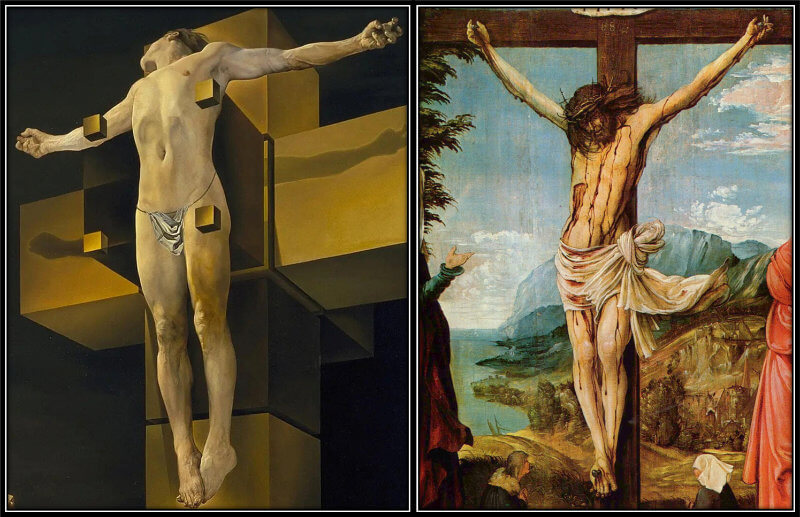
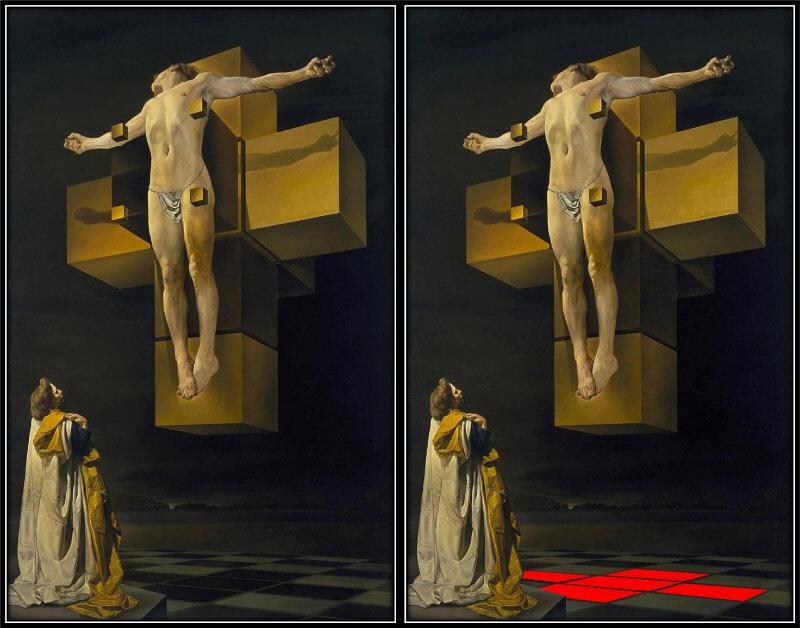
At its heart, Crucifixion (Corpus Hypercubus) presents a surrealist version of the biblical event of the crucifixion of Jesus Christ. A golden polyhedron of a four-dimensional cube (aka tesseract) hovers, unfolded, over a checkered floor. A figure, whom we can reasonably assume to be Jesus Christ, appears to float unconscious, with his back to the polyhedron and without actually touching it, while four additional three-dimensional cubes float in front of him.
Standing on a platform, we see a woman in antique attire holding a golden robe and looking up at Jesus. Experts generally agree this woman represents Dalí’s wife, Gala Éluard Dalí, whom Dalí often portrayed in his works. The background is dark and apocalyptic, and we glimpse mountains in a deserted landscape.
What can I say? Another Dalí, another masterpiece.
Truly, sometimes a picture is worth a thousand words. Just look at Crucifixion (Corpus Hypercubus); it has all the elements that, to me, elevate a surrealistic painting stand head and shoulders above the rest. Dalí’s masterful brushwork in a distinctly classical style, is not only appropriate given the painting’s religious subject matter, but also incredibly precise and beautiful. The sense of depth in jaw-dropping; the texture of the fabrics, the folds and creases of the robes, and the meticulous and clean lines delineating the edges of the cubes are rendered with astonishing realism. The careful employment of light and shadows ties everything connected. All of these elements combine into a work of art that feels not only beautiful, but complete and fully realised.
But, Dalí being Dalí, aesthetics weren’t his only concern. Crucifixion (Corpus Hypercubus) belongs to his works so-called atomic period, during which Dalí sought to blend science with mysticism. And it works beautifully!
The central motif is, of course, Jesus Christ on the cross. Unlike the biblical account, there is no overt indication of suffering: Jesus’ face is turned away from us, and, there are no visible lashes, cuts, or wounds on his body. At the bottom right of the composition, standing on a raised platform, a woman (perhaps Mary) holds a mantel and looks up at Jesus with a calm, almost emotionless expression. Thus, while the viewer inevitably associates the scene with a narrative of pain, fear, and suffering, the painting itself remains serene and contemplative.
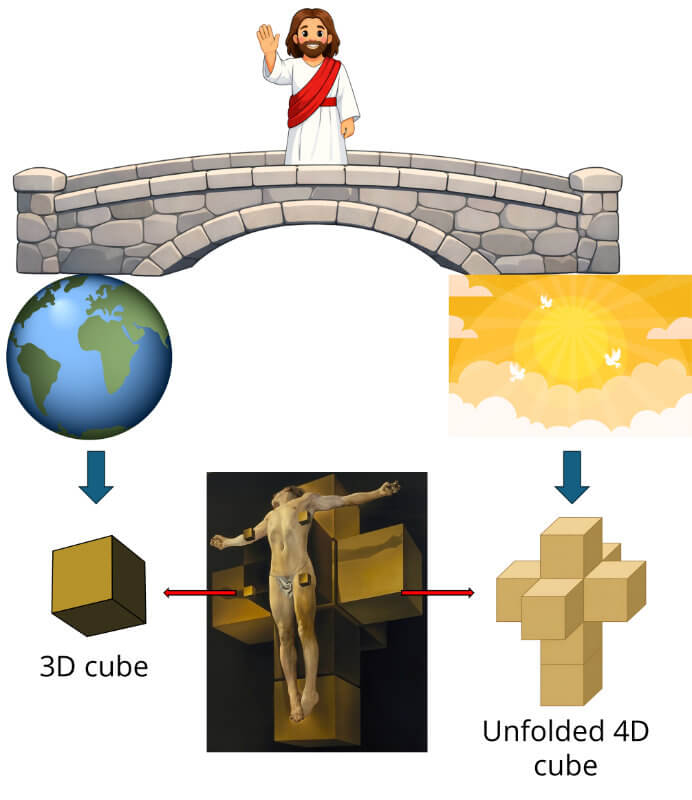
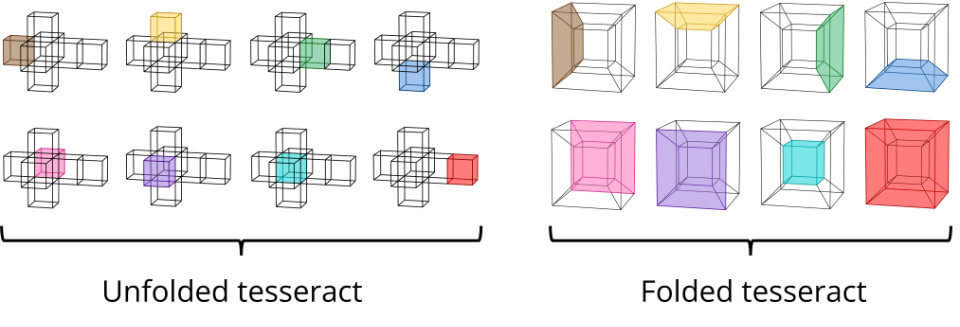
And did you notice what kind of cross Jesus Christ is being crucified on? A tesseract. A tesseract! Let me tell you, I’ve been working my arse off day and night for the last few months trying to get to grips with the damn thing, using every convenient tool at my disposal, and I’ve still only managed to acquire a very superficial understanding of it. OK, I may not be the cleverest among us, but I’m no idiot either. Out of all possible concepts, Dalí chose one of the hardest to translate into images, and, somehow, he succeeded, despite having no formal training in mathematics.
I sometimes daydream that Dalí somehow sat down in a haven of the leading physicists of his time (and there were many: Albert Einstein, Niels Bohr, Werner Heisenberg, Erwin Schrödinger, Max Planck) discussing the possibilities of a fourth-dimensional space. There is, of course, no historical evidence that Dalí ever met any of them, but what can I say?, I like to daydream.
Dalí’s fascination with ideas far outside his own field, combined with his ability to grasp the core concept of higher dimensionality and depicting it so convincingly, just shows how multifaceted an artist he truly was. Humans, after all, cannot directly conceive of a tesseract; our brains simply aren’t equipped to think in more than three spatial dimensions. So, mathematicians rely on various conceptual tools to build some intuition for the fourth dimension. The unfolded tesseract, which Dali brilliantly and accurately renders in the form of a cross, is one of such tools.
And I guess that is why I love Dalí’s art so much. It is not only that it looks amazing, or that it captures drama so effectively. It is the story, the literal narrative that his paintings convey.
With Crucifixion (Corpus Hypercubus), that story is immediately apparent. Drawing on the biblical account of Christ’s crucifixion – a pivotal moment in Christian faith, where Christ sacrificed himself to bear humanity’s sins and offer a path to salvation, as well as from the abstract concept of four-dimensional space, Dalí bound two of the most distinct realms: religion and science. Dalí was openly anti-religious in his youth, but his views on religion changed as a consequence of witnessing the horrors of WWII. Thus, it is unclear if Dalí was simply amused, or if this particular biblical event somehow resonated strongly with him.
Perhaps the answer is a little bit of both.
Star rating
It’s perhaps not surprising that I am reviewing, yet again, a Dalí painting. If you have been a recurrent visitor to Mindlybiz, you should by now have realized that I consider Dalí the greatest of surrealist artists. Crucifixion (Corpus Hypercubus) is yet another fine example of why I feel so attached to Dalí’s art.
In a single composition, Dalí managed to bring together two of the most divergent fields in the history of humanity, religion and science. By accurately depicting the unfolded fourth-dimensional cube, Dalí shows his acumen for delving into deep philosophical and mathematical concepts, at a time, mind you, when there was not nearly the amount of learning materials it exists today.
There is really no other rating the Crucifixion (Corpus Hypercubus) should get than full 5 stars.
Bizarrometer
The Crucifixion of Christ and the Tesseract, what do you expect? It is weird alright. Dalí’s paintings during the Atomic Period, which combined science with religion, are among some of the most enigmatic of Dalí’s painting. The general theme of the painting, however, isn’t as obscure as perhaps some of his other works.
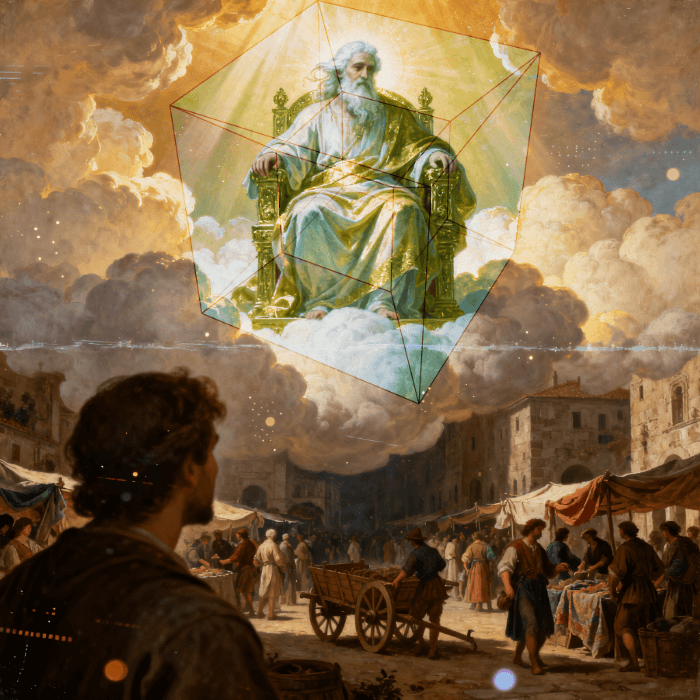
Prior to Dalí’s Crucifixion, several artists and writers had already depicted the divine via recourse to higher dimensions. Of course, Dalí adds extra elements, such as the connection between higher dimensionality and divine transcendence, that make this work of art uniquely bizarre.
Crucifixion (Corpus Hypercubus) gets a bizarrometer score of 3.5.
Leave a comment
Add Your Recommendations
Popular Tags