Top 10 Surrealist Paintings at the Menil Collection
Not very long ago I travelled to Houston with the sole aim of visiting the Menil Collection. If you are familiar with my posts, you’ll know why. The Menil Collection holds one of the most impressive collections of surrealistic art in the world! Their catalogue of René Magritte and Max Ernst works is particularly extensive and impressive, and the reason their works predominate the list below (which could have well turned into a Magritte vs Ernst battle).
Despite having to battle through the chaos of Houston traffic, walking along some rather dodgy streets, passing by supermarkets with barred windows, having to leave my bag outside before entering shops – only to witness theft shortly after – wasn’t a deterrent to visit this fabulous museum.
I arrived there before the doors opened and left at closing time. There is so much surrealistic art that you could spend hours appreciating it. And it was only later that I realised the Menil Collection actually rotates their paintings from time to time, so I probably saw only a little fraction of their holdings.
With the intent to whet your appetite for a visit to this little gem in the heart of Houston, I’ll list the 10 surrealistic paintings I found most impressive during my visit.
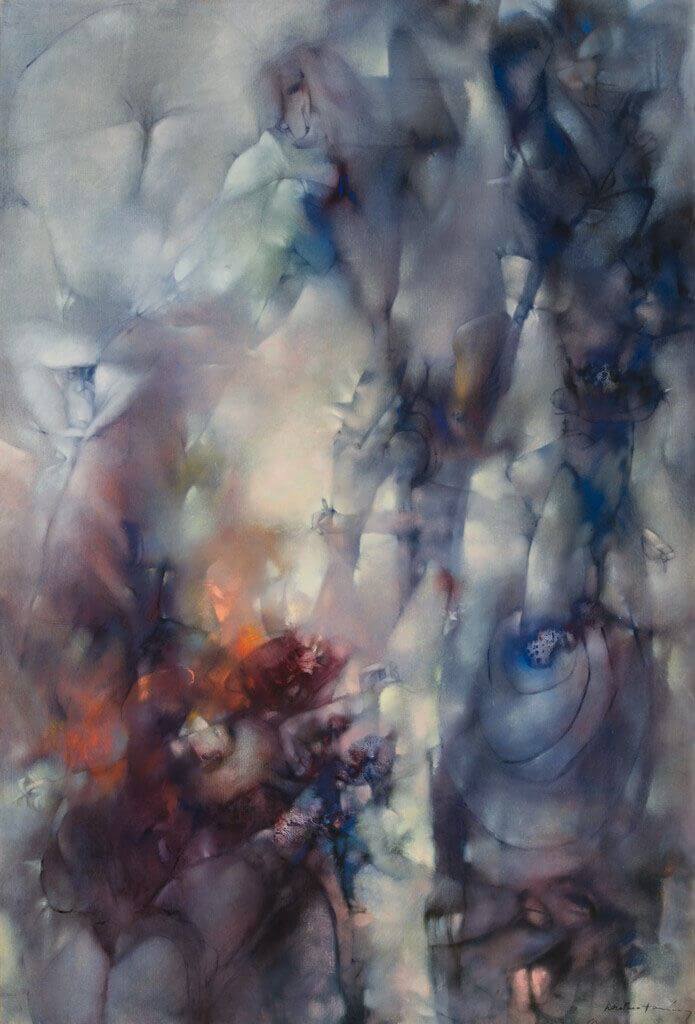
10. Tourists of Prague III
by Dorothea Tanning
Whether Prague or tourists are indeed depicted in this abstract painting is pretty much open to interpretation. Amorphous figures with hints of bodily shapes inundate the canvas. Dominated by blue tones with an area of concentrated red on the left, The Tourists of Prague III is chaotic. The positioning of the figures, all jumbled together, remind me of a crowded Prague indeed (or maybe an orgy, who knows).
Not being a fan of abstract art, I have to say I was surprised to have liked this painting. The tentative human shapes of what I construe to be the “tourists” blend with nebula-like formations. Tanning’s masterful use of curved contours and colour shading gives the shapes in The Tourists of Prague III an incredible sense of depth, almost three-dimensional.
I’m not sure what it is exactly, but there is something hypnotic about this painting. And even though I’m unable to make out what on Earth Tanning had in mind with Tourists of Prague III, I could not help but feel a certain connection with it.
2.5 / 5
Soso
5 / 5
Utterly bizarre
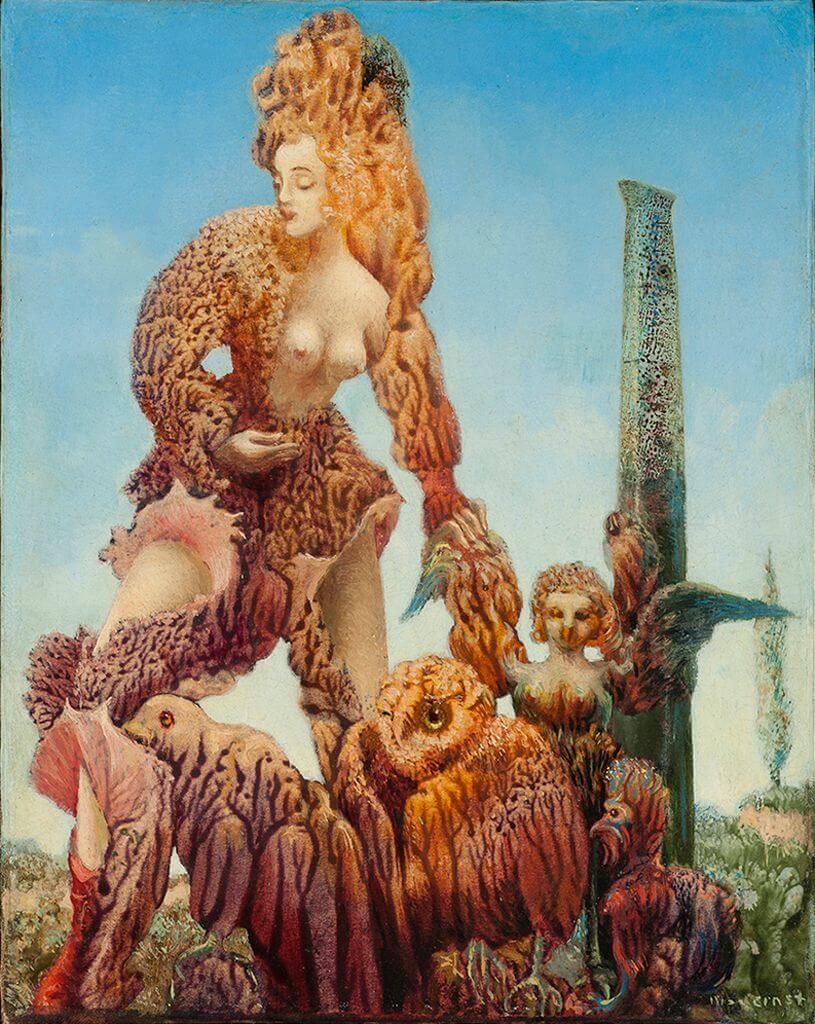
9. Marlene
by Max Ernst
In Marlene, a half-naked woman is seen moving away from a column and cypress tree. She is accompanied by four bird-like creatures, their bodies covered in the same coral-like texture that envelops the woman’s body. Her facial expression evinces a certain sadness and resignation.
One immediate peculiarity of this painting is the coral-like texture covering both the woman and her aviary entourage. Because of Ernst’s life circumstances when he painted Marlene, the work has been subject to several interpretations. After the outbreak of the Second World War, Ernst was imprisoned in France, and Marlene was created during that period. Some art historians believe the painting is autobiographical, a commentary on migration, exile, imprisonment and escape.
Even though Marlene isn’t my favourite painting by Ernst, it is undoubtedly moving. Knowing the hardships Ernst must have endured (he was openly anti-fascist, making him a prime target for the Nazis), the emotional weight of these experiences transpires in this painting.
3 / 5
Satisfactory
2.5 / 5
A Bit Weird
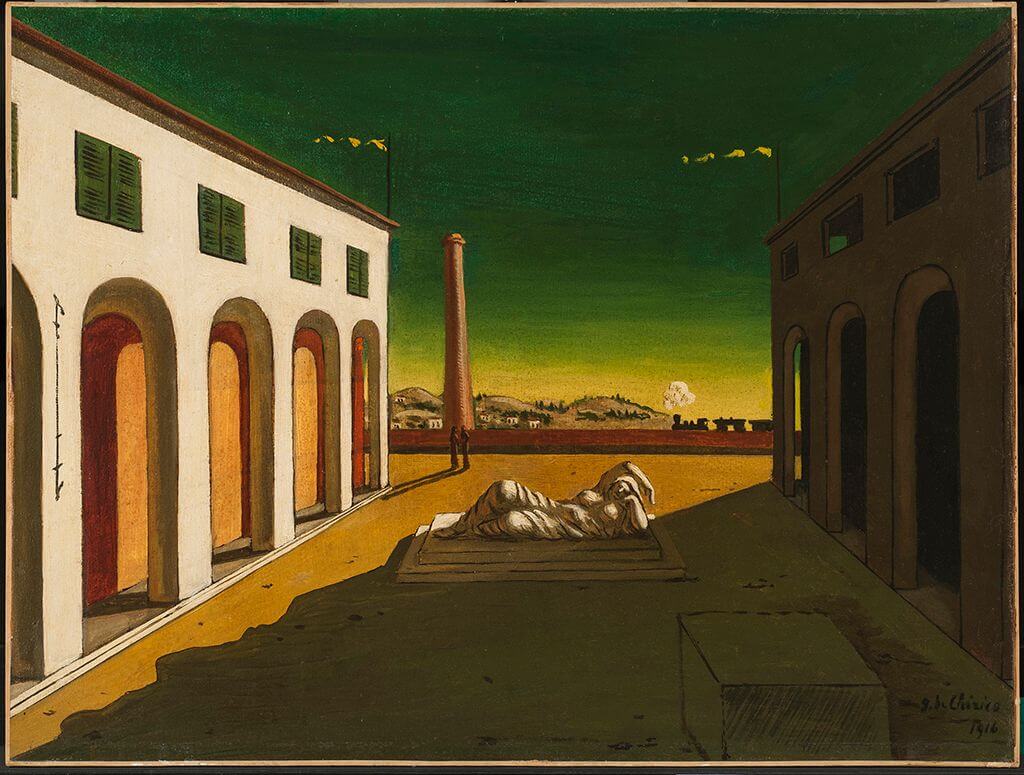
8. Melancholia
by Giorgio de Chirico
Considered one of the founding fathers of Surrealistic movement, Giorgio de Chirico was a prolific painter, and Melancholia is one of his best-known works. A sculpture of a woman in a classical, Renaissance-inspired style stands in a largely empty square, forming the central element of the composition. In the background we see a train, the only hint at movement in an otherwise static scene.
Melancholia is aptly titled. This painting exudes loneliness and sadness. Despite depicting what could be a relatively ordinary scene (just a statue in the middle of an empty square), there is no denying that it has a strange, surreal vibe.
But what is it that feels so strangely disturbing? What is it that makes me anxious just imagining stepping into that square? Melancholia could well be a place in some remote Italian town, but there is something off about it that continues to elude me. And I enjoy that feeling!
3 / 5
Satisfactory
0.5 / 5
Not very weird
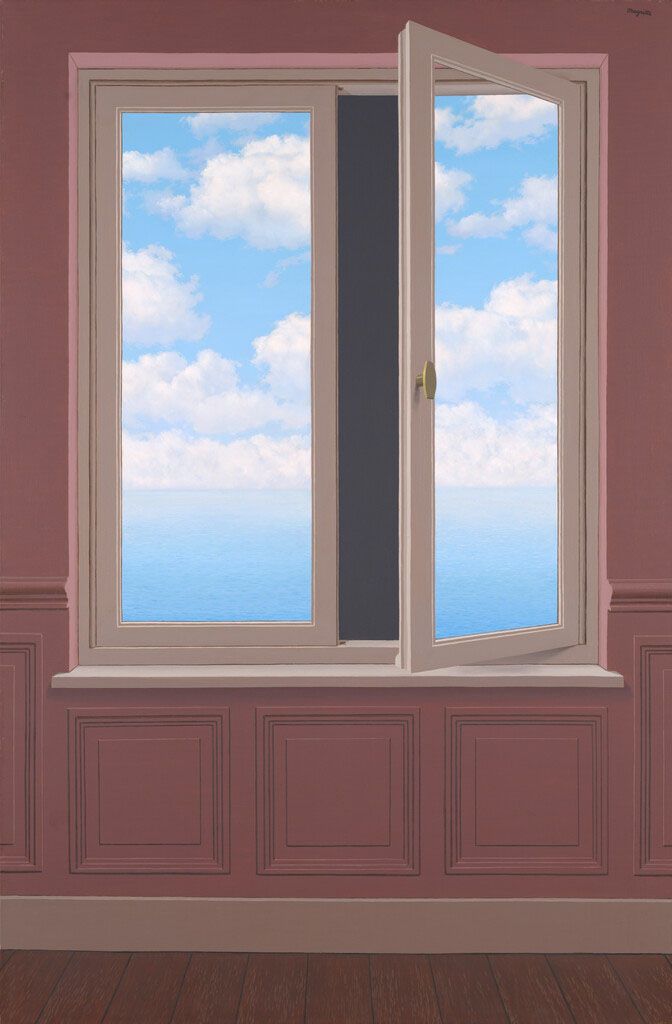
7. The Telescope
by René Magritte
An ordinary window seemingly reflecting the deep blue sea and the clouds forming above it. Only it isn’t a reflection, but instead the distant horizon of sea and sky seen through glassless windows. Only it isn’t the horizon either, as the slightly open window lets us see the pitch darkness outside.
As is customary in Magritte’s work, The Telescope isn’t flamboyant or ostentatious, but playful and meticulously precise. Whereas examining a Dali painting can be exhausting (Dali being my favourite painter, mind you), I could spend hours visually dissecting a Magritte. His impeccable brushwork and subtle use of surrealism are a feast to the eyes.
I bet most of you initially dismissed the surrealness of The Telescope by claiming it is either a reflection, or the actual horizon seen through the window. But it is actually both… or neither. Magritte excelled at these kinds of visual paradoxes and incongruities. But if it’s both (or neither) a reflection or (nor) the horizon, what does this even mean? It makes your head spin, I know! Magritte, you troll…
3 / 5
Satisfactory
3 / 5
Moderately Weird
6. Memory of a Journey
by René Magritte
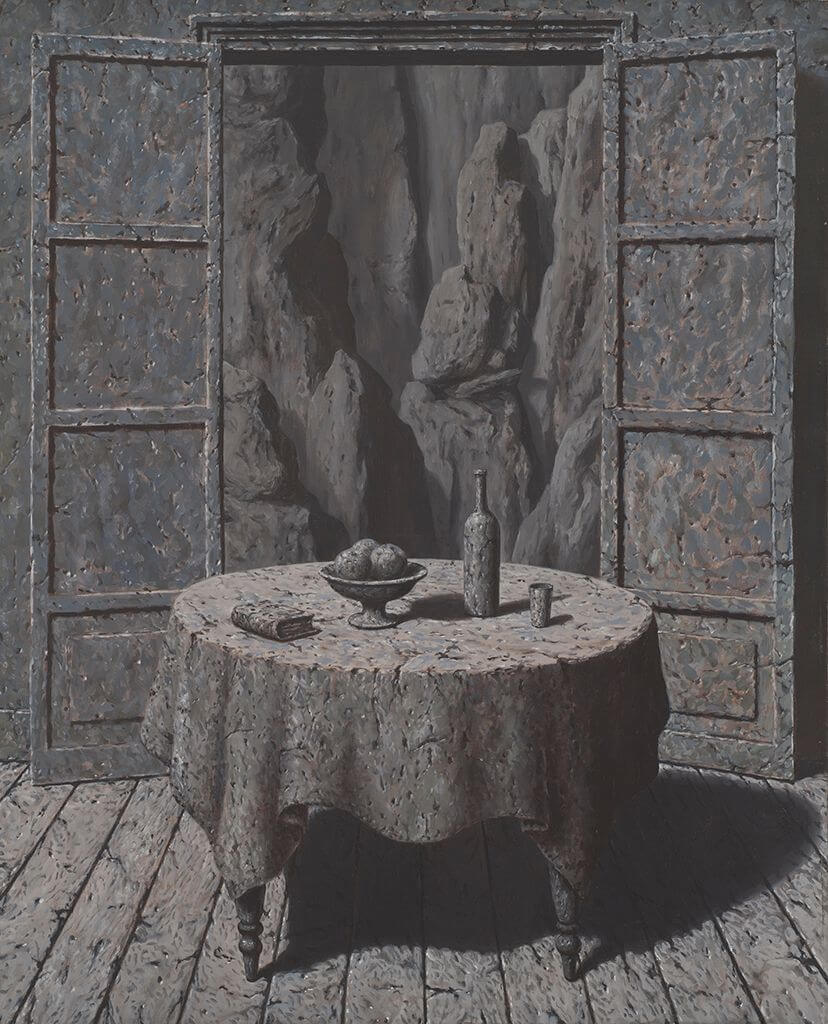
A table, a bowl of fruit, a wine bottle, a glass and a book, along with the room that contains them, have all been petrified into stone. Through the opened windows/doors we can glimpse the outside cliffs, their rock appearing identical to the material making up the petrified objects.
In Memory of a Journey, everything is still; nothing is alive. We can almost “hear” the silence and feel the loneliness of a forgotten place. Perhaps once inviting, the stone house is now at the mercy of the same elements that will erode all rocks into oblivion. Still, what better way to describe a consolidated memory than hard stone?
I have a penchant for monochromatic paintings, and I find this work particularly impressive. Once again, Magritte proved that his skill in creating hyperrealistic textures is unmatched. But, to me, Memory of a Journey is not only a showcase of Magritte’s technical mastery, it is also a philosophical work. After all, isn’t a memory itself a legacy of a journey once taken?
3.5 / 5
Good
2.5 / 5
A Bit Weird
5. Golconda
by René Magritte
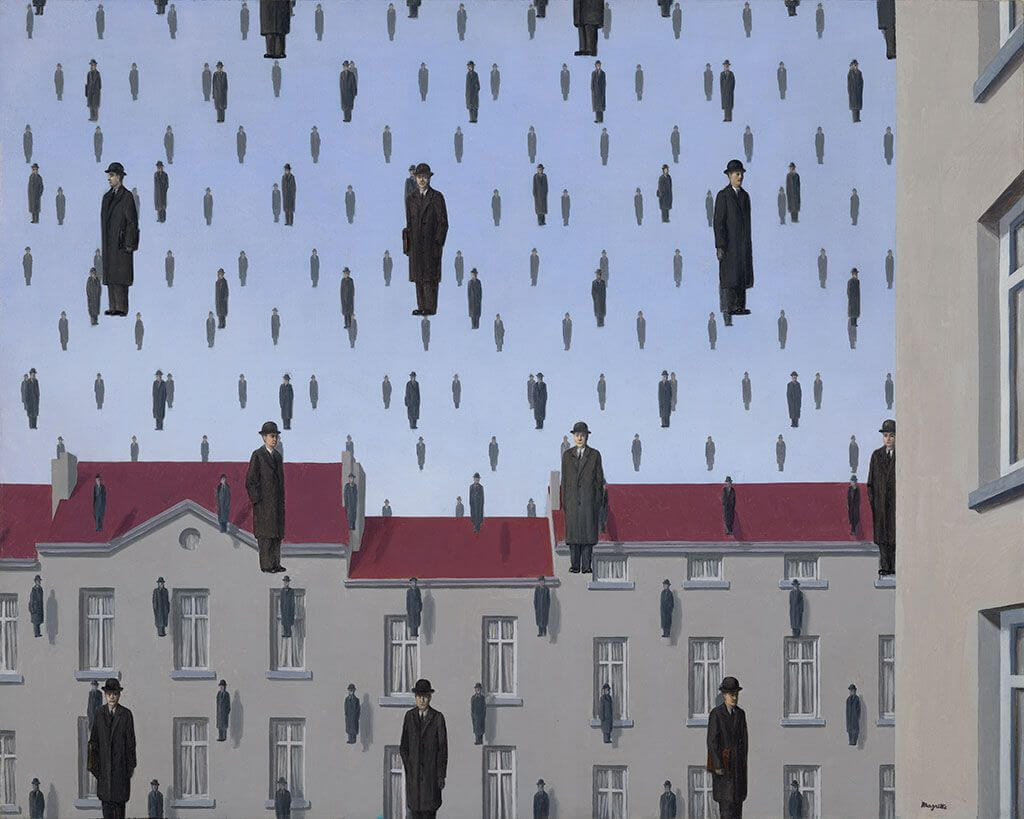
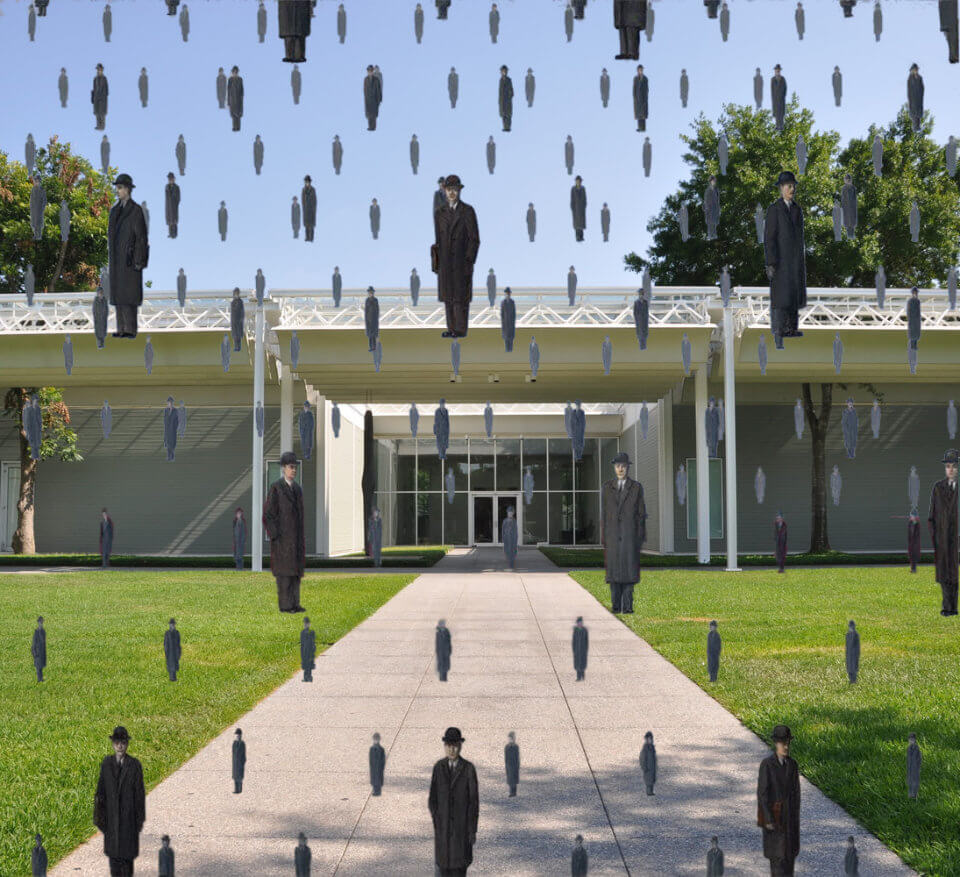
It’s raining men! Well, not quite. Golconda shows us several men dressed in overcoats and bowler hats floating in the sky, with red-roofed houses in the background that may be Brussels. The men look passively in different directions, seemingly unaffected by the fact that they are several meters above ground. The shadows on the buildings make it clear that these men are truly floating in the sky, without any hint of motion.
Golconda, Golconda, Golconda… An ancient ruined city in India. What could be more relevant? Yes, I’m being sarcastic, because I cannot for the life of me see the connection between floating bowler-hatted men and this ancient city famous for its diamond mines. Perhaps Magritte was attracted to the enigmatic-sounding word, or its phonetic similarity to a certain Gioconda? Or maybe the name Golconda is a playful metaphor, in that the repetitive men represent abundance, just as Golconda became synonymous with wealth and abundance in European imagination. Who knows…
In any case, Golconda has a special place in my heart. While I was at University, I would pass by a copy of Golconda almost every single day on my way to class, telling myself that one day I’d figure it out what it means. I still haven’t, but this experience marked pretty the beginnings of my interest in surrealism, so I won’t hide that its place in this list is partly sentimental.
3.5 / 5
Good
4 / 5
Quite Bizarre
4. Day and Night
by Max Ernst
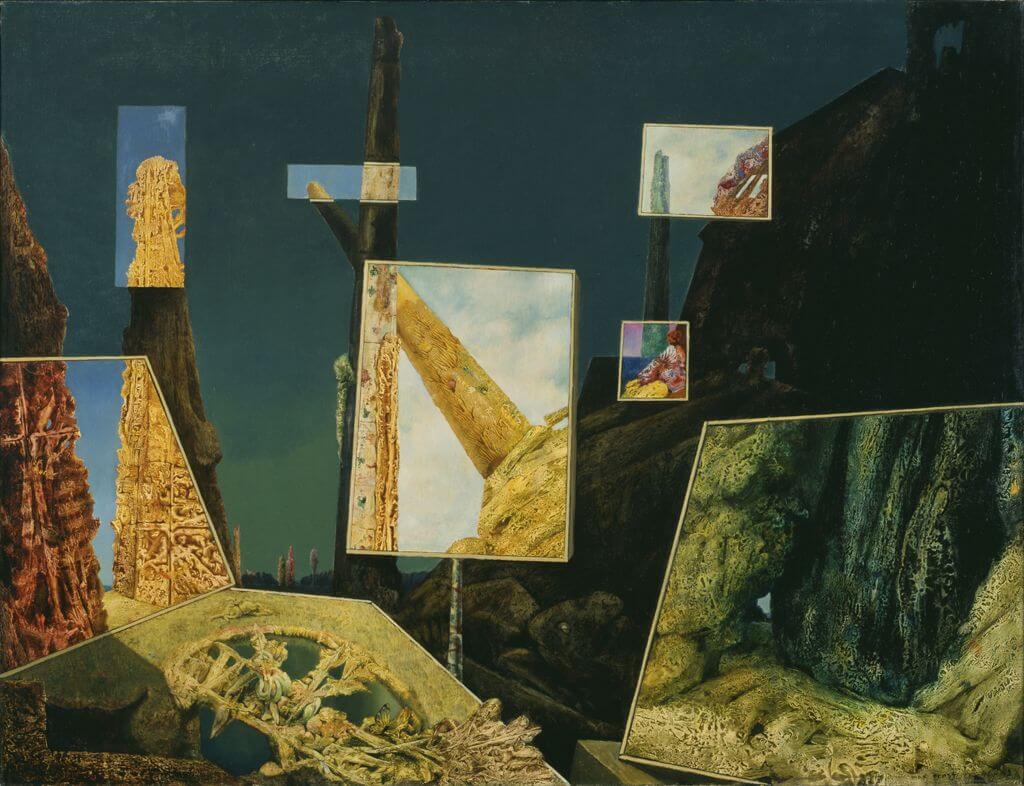
In Day and Night, a dark otherworldly landscape of rocky towers contrasts with the brighter paintings of parts of the same scene in the foreground.
I cannot say if Ernst took inspiration from Gaudí, but it sure looks hella like it. The pointy rock formations, with their intricately sculpted motifs, bear a striking resemblance to the spired towers of the Sagrada Familia with its exquisite engravings and carved details; likewise, the cavernous formations at the bottom right of the painting remind me of the The Laundry Room Portico in Parc Guel. The fine details and masterful play with contrast add the cherry on top of the cake.
I love this painting! You see, at first, you might think that it’s dark outside and the foreground paintings are only depictions of a daylight versions of parts of the background. But then you realise that some of these “paintings” are frameless, seemingly floating precariously in the air. One could argue that the “paintings” are actually coloured specks, almost as if the background itself is a painting. Brilliant!
3.5 / 5
Good
4 / 5
Quite Bizarre
3. A Swarm of Bees in the Palais de Justice
by Marx Ernst
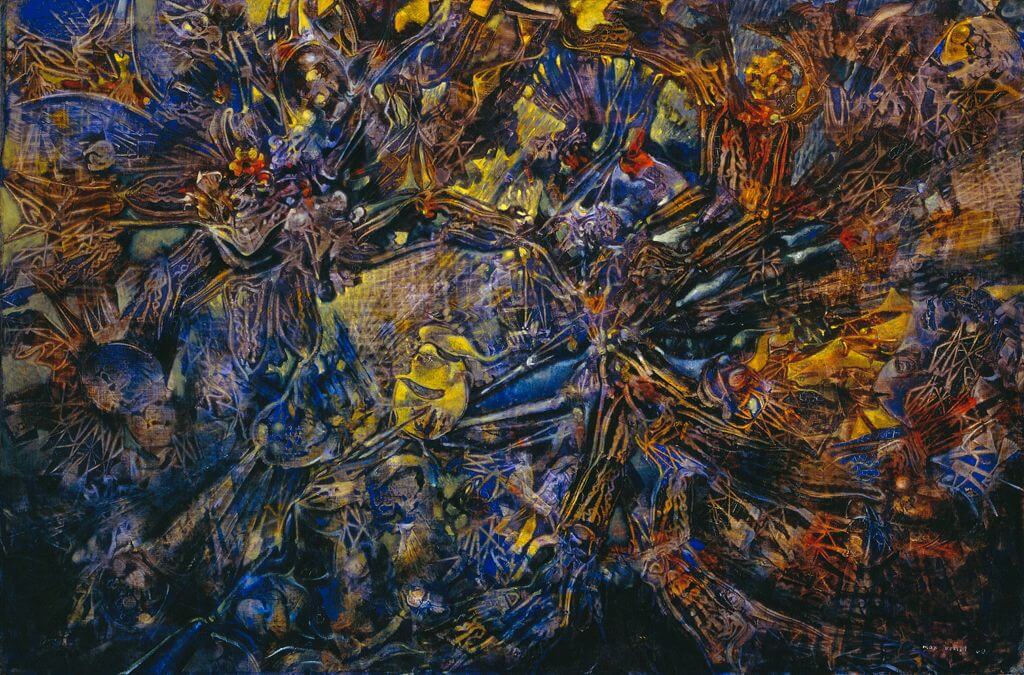
A frenetic and vibrant painting, A Swarm of Bees in the Palais de Justice ostensibly depicts bees buzzing through the Palais de Justice in Paris. The cacophony of colours is staggering, as is the illusion of movement, made even more impressive by the lack of clearly identifiable objects.
There is something intimidating about this painting which I cannot fully rationalise. It is clear that the brilliant choice of palette – mostly blues and reds with darker shades – has something to do with it. The complex grid- or web-like pattern implicitly gives off an intimidating feel, almost as if we had entered an arthropod world… and we were the prey. The number of associations that crossed my mind was vast, ranging from bees in some alternate reality, bees as seen in some obscure light frequency, or robotic, transformers-like bees.
If memory serves, I remember coming into the room where this painting was located, looking left and having a brief visual shock with all the frantic hubbub. I might not have identified where the bees were in the painting, but as sure as hell it felt they were about to furiously chase me down the gallery :D.
4 / 5
Really good
3.5 / 5
Very Weird
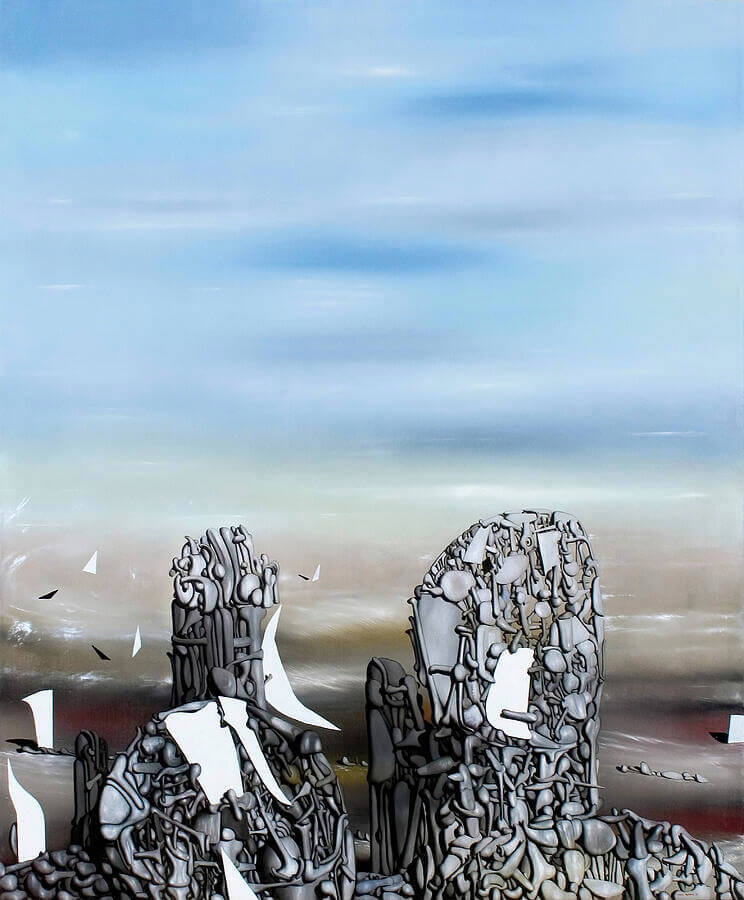
2. The Hunted Sky by Yves Tanguy
by Yves Tanguy
The Hunted Sky features metallic-looking fragments piled into a series of hills. In the background a few elements resembling paper birds or kites fly across the sky, while the barren landscape seems devoid of life.
This painting was probably the most pleasant surprise during my visit to the Menil Collection. I had zero knowledge of this type of art and had never heard of Yves Tanguy. But, gosh, what a formidable painting. The textures of the metal pieces are perfect, and the way Tanguy employed shadows makes it look as though they are popping out of the canvas. Moreover, what at first sight looked like a heap of metal scraps in a junkyard, upon closer inspection, revealed order among the chaos. The intricate interlocking of shapes appeared meticulously planned.
To be honest, I haven’t figure it out what all those metal shards are supposed to represent. The organised manner in which the pieces are arranged though, makes me think their placement in the mounds is fully intentional. Maybe Tanguy wished to depict the landscape of an extraterrestrial planet, the mounds having symbolic significance to its inhabitants? Clearly, I’ve been watching way too much scify lately…
4.5 / 5
Excellent
2.5 / 5
A Bit Weird
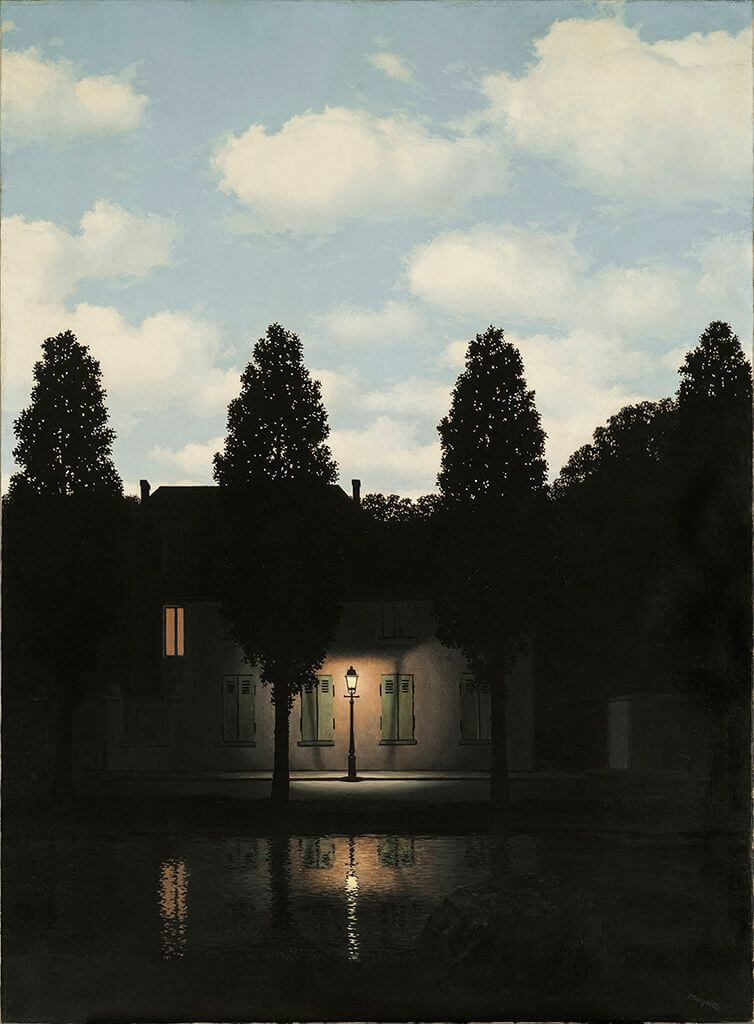
1. The Dominion of Light
by René Magritte
A house by the lake is illuminated by a single lamp deep into the night. Wait! Did I say night? No, I meant in broad daylight. Wait! No. Otherwise there would be no need for the lamp, which is clearly illuminating the house in the dark… Ahhh, Magritte, you did it again!
I’m not really sure when exactly I started enjoying this painting because I’ll be honest, the first time I thought “OK, what’s so weird about this?”. It was my then-girlfriend (now wife) who actually pointed out the paradox in the painting. A bit embarrassing, really, since I love surrealism and she isn’t a big fan…
Magritte was a master at fooling people, and he did fool me… yet again. But since then, The Dominion of Light has been an all-time favourite of mine. The immaculate brushstrokes, the way the colours blend seamlessly in the dark section, the flawless reflection of the house, trees, and lamp on the water, the warm, earthy glow of the lamp providing the only illumination at night, and the subtle, ingenious surrealism make this an unparalleled masterpiece. Brrrr… just thinking about it gives me chills.










Leave a comment
Add Your Recommendations
Popular Tags