
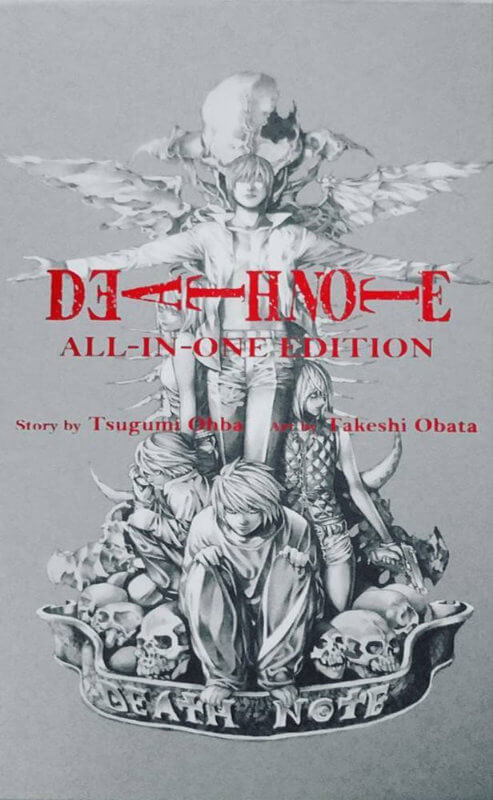





Death Note is one of those works I’d long known was an indispensable read, but always postponed until the moment was right.
The manga (and anime) rank among the best that there is in the medium, so I wasn’t ready to lose the thrill of discovering it for the first time (the same thing is happening with Attack on Titan – when will I finally read it?!?).
What prompted me to start reading it was the offer of the mega-volume at a ridiculously low price. So, I took this as a sign, and embarked on a long-overdue journey.
The manga is really that good! I was so involved in the story, I couldn’t help but let out brief exclamations of excitement. You might think this is normal, after all, everyone occasionally lets out brief bursts of enthusiasm. But I never ever do that.
It was simply too difficult to contain myself – Death Note is a real page turner. The chapters are short, there are hardly any fillers, and they almost always end on a cliffhanger. I’m telling you, you’ll turn the pages one after another just to see what happens next. It’s inevitable!
Review
Light Yagami, a handsome and intelligent 17-year old Japanese boy, accidentally stumbles into a notebook (the Death Note) that allows him to kill people by writing down their names on it. Driven by a self-righteous sense of justice, Light uses the alias Kira to wreak havoc, killing every criminal he deems unworthy to live. With the Japanese Police in turmoil, L, an awkward and solitary super-detective, is called in to uncover Kira’s identity and prevent further assassinations. What follows is a thrilling cat-and-mouse battle, as Kira and L try to outwit one another in a relentless psychological duel.
What a manga!
For starters, the artwork was pretty good. It’s unmistakably manga in style, so you will find the typical features of large expressive eyes, incredibly elongated limbs, and flawlessly smooth skin. But even by manga standards, I found the line work immaculate. Just take a look at some of the drawings:
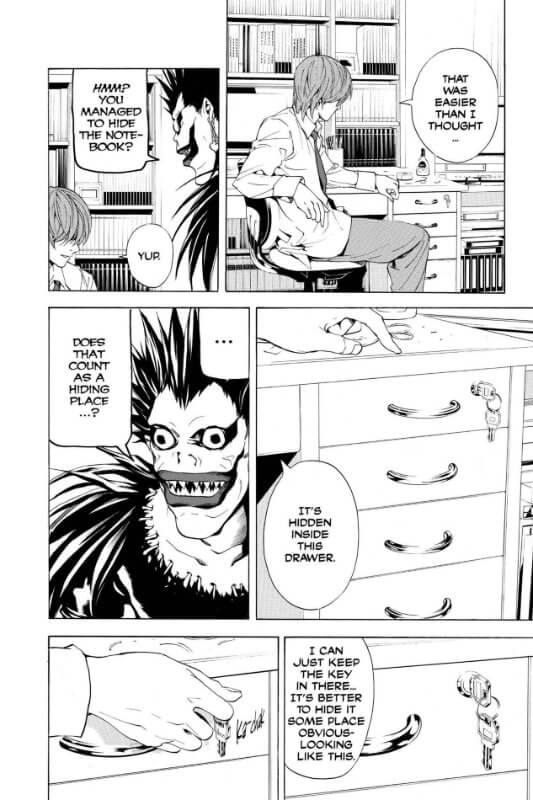
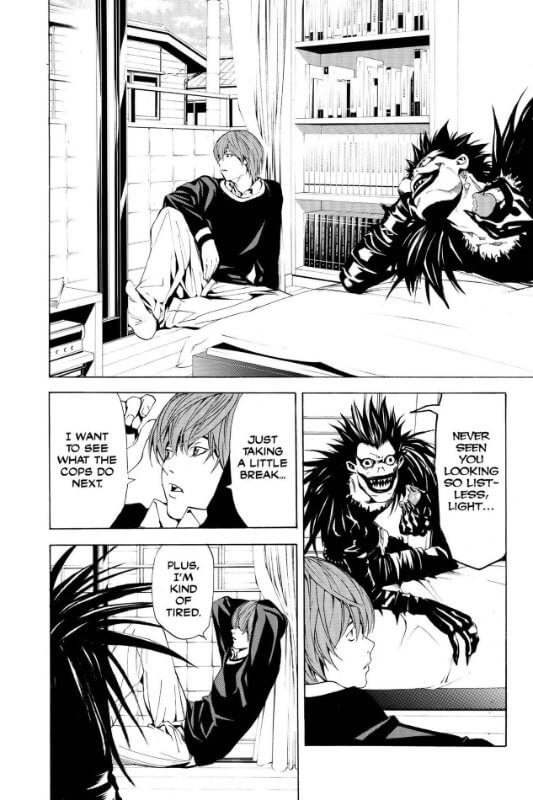
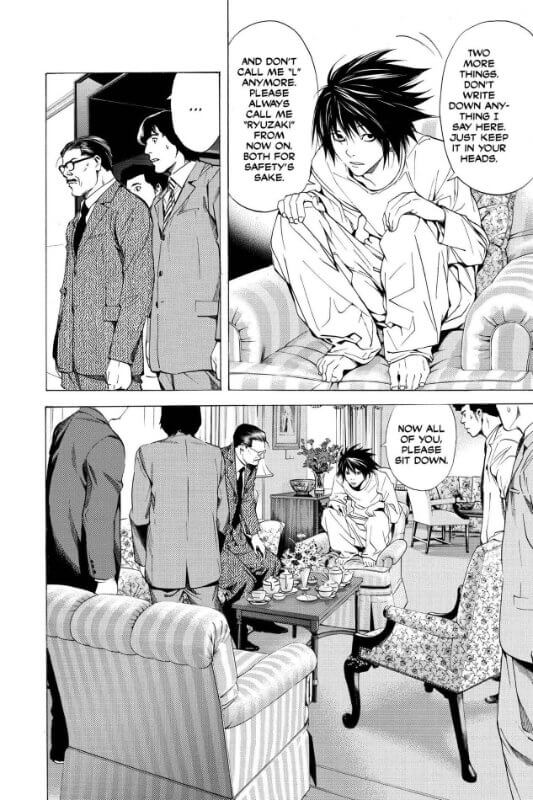
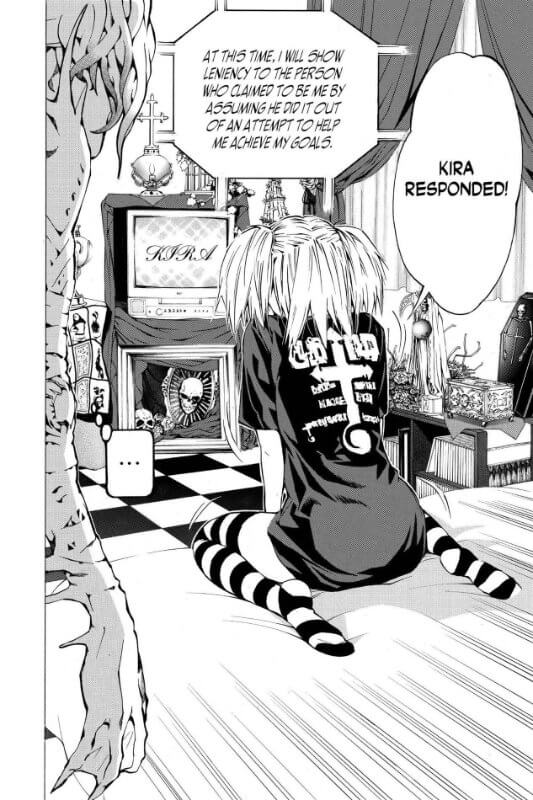
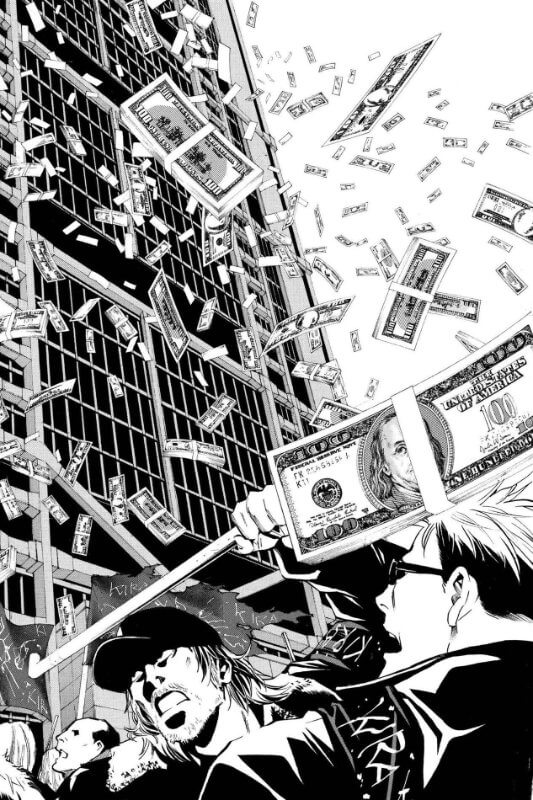
They are exceptionally clean and detailed.
The story is extremely well-devised and flows naturally. This is impressive given that Death Note was serialised in weekly publications (from December 2003 to May 2006). There is no shortage of manga that has fallen victim to the harsh reality of weekly publishing, and I was concerned this might negatively affect the story as it progressed. Much to my delight, Death Note never once lowers the bar with respect to the quality of its narrative.
There are essentially three “sections” to Death Note: Kira vs L, Kira vs Yotsuba and Kira vs N/M. Although I enjoyed the original Kira vs. L storyline the most, all three sections introduce fresh elements, ensuring the story never really stagnates. A case in point is that each of Kira’s antagonists has their own peculiar personality quirks: L is a reclusive teenager with an insatiable sweet tooth; N is an introvert kid obsessed with figurines; M is a chocolate-addict gangster.
While many of the main characters remain, some die abruptly and unpredictably. This was a bummer at times, but the authors always managed to keep the narrative engaging. In fact, even if Death Note was not planned in its entirety from the outset, the transition between its different sections is hardly noticeable .
Even though I thought some of Kira’s thought processes were a bit convoluted at times, the battle of wits between Kira and L was very well conceived. For most of the story, I was genuinely impressed by Kira’s and L’s meticulous reasoning. I particularly enjoyed the fact that the narrative was not structured as a typical whodunit, where the reader only discovers the culprit at the very end. Instead, we know from the very beginning who Kira is, so the tension lies in the process of exposing him and not falling into his traps. It was refreshing to see L exhaust nearly every conceivable possibility. Indeed, I often found myself thinking along the same lines as the police task force (raising obvious solutions/objections), only to have L explain, almost like a dad patiently correcting his young son, why each proposal would ultimately fail.
And let me be honest with you: I’m not really a fan of crime stories. Yet, I very much enjoyed Columbo and I cannot help but see a parallel with Death Note. Just like Columbo, L spends much of his time trying to lure Light, who L suspected of being Kira, into making a fatal mistake.
As characters go, many readers have expressed their dislike for N and M, but I found their addition compelling. Despite appearing to survive almost entirely on chocolate bars, it was intriguing that one of the few individuals that could challenge Kira was a reckless gothic with ties to the organised crime. It was a striking contrast with his rival N, who is calm, introverted and methodical, always meticulously calculating his next move.
Do you notice how frequently I use the pronouns he, his and him? That is unfortunate because, once again, I felt the story lacked a strong female presence. Misa (arghhh) is frankly atrocious, while the other female characters lack character, and largely insubstantial to the progression of the plot. Naomi was one of the few women who provided a welcome reprieve from the overwhelmingly male-centric narrative. Sadly, the character was killed off far too early, leaving little time to fully appreciate what she could have contributed.
Thematically, there is quite a lot of food for thought in here. Manga are typically known for their philosophical undertones, and Death Note certainly doesn’t disappoint in this respect. It does not have the kind of dreamlike or symbolic imagery that more abstract, surrealistic manga do, but it is nonetheless rich in moral and ethical dilemmas. Is it just to kill the worst criminals if doing so creates a safer world? Would reducing crime rate to 70%, 80% or 90%, justify the deaths of a few evil individuals? Is it morally defensible to use the Death Note on violent criminals if it spares innocent lives and allows decent people to pursue happiness? These are precisely the sort of questions that drive Kira to assume the role of both judge and executioner.
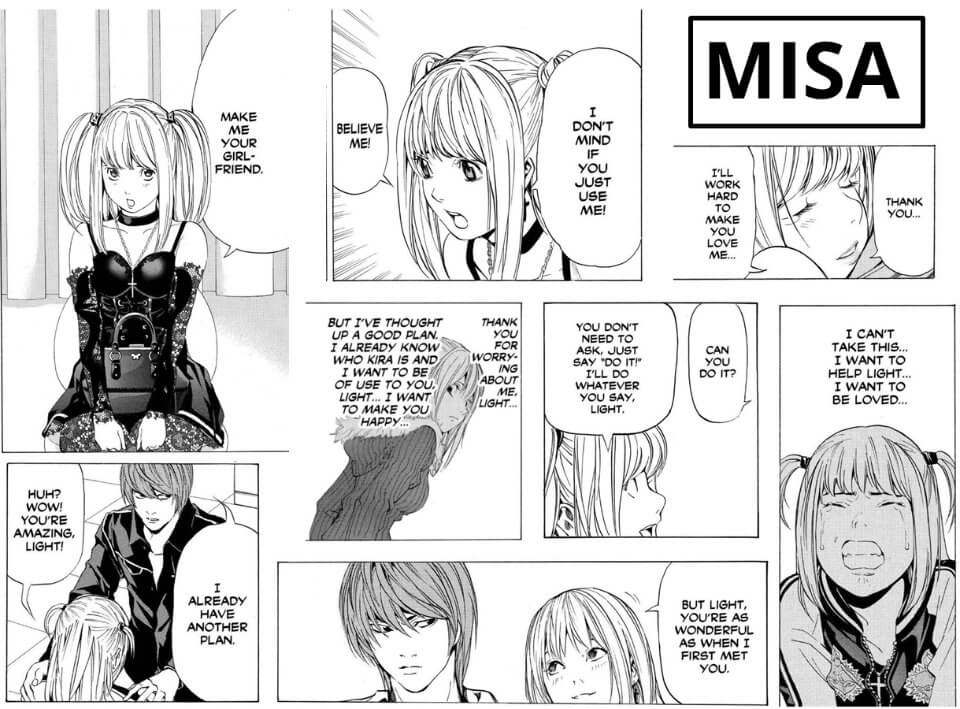
Now, for my biggest criticism: Misa Amane. Gosh… where do I even start?
So, Misa is this insecure girl, hopelessly infatuated with the golden boy – it is so damn cliché… The endless stream of “Oh Light, be my boyfriend”, “Oh Light, it was love at first sight”, “Oh Light, I’ll do anything you want me to do”, “Oh Light, I’ll die for you” just really, REALLY annoyed me. It is difficult to reconcile Misa’s childish and irrational behaviour with the fact that she is supposed to be a highly successful model and actress, on the verge of breaking into Hollywood.
And it isn’t just her clinginess that bothered me. There is no reason at all she should be so obsessed with Light (it can’t be the fact that Light is Kira, because when she temporarily loses her memories, she is just as clingy, if not more). At one point, she tells Light that she won’t have to kill the other girls who are attracted to him since she knows he is using them. Ryuk ponders how this girl cannot understand that Light is using her as well. Can love really make someone that blind?!? (yeah, I guess it can…)
You might argue that Misa’s blind love for Light is the very reason why Light keeps her around (since he only connects to people he can manipulate). Fair enough. But note how Misa is smart only when the plot requires her to be. For example, she never accidentally links Light to Kira in front of others. Yet, she is portrayed as impulsive and emotionally unstable, as evidenced by the scene in which she gets drunk, threatens Takada and says she is going to marry Light. Also, Misa cunningly found out that Light was Kira on her own. Yet, she was foolish enough to show up at Light’s door, putting both at risk.
If you are anything like me, you might have found yourself wondering: what on earth happened to Misa?
Misa’s abrupt disappearance near the end of the manga is perhaps the clearest indication that she functioned more as a plot device than a fully realised character.
So, Misa had been a recurrent and pivotal presence in the manga for pretty much the entire story. Yet, once she is released by Near and placed in a hotel, she remarks: “I don’t know why, but I’m in a deluxe suite at the Teito hotel. Must be their way of apologizing or something. It’s great!” (p 2180).
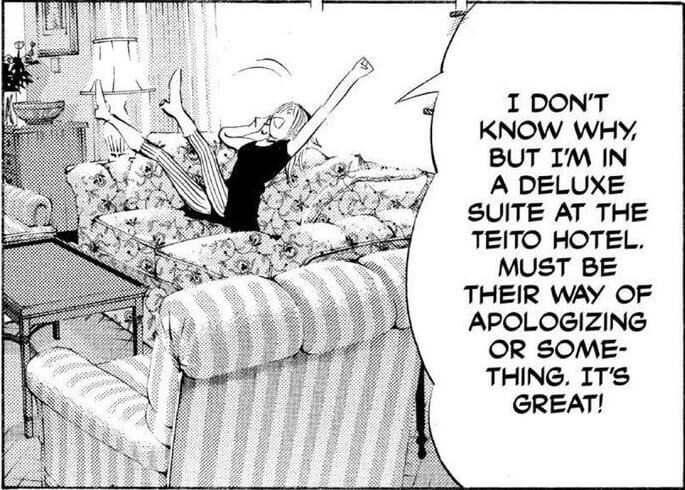
And, then, puffff… No Misa no more; she simply vanishes from the narrative. But why?
Well, because, by that point, she has become redundant as far as the story is concerned. She has fulfilled her functional role as Kira’s pawn, so the story no longer needs to keep her in play (typical plot-device character). No closure, no consequence, no reflection.
But despite my many criticisms of Misa, I really think for someone who had spent so much time in the spotlight would at least deserve a proper ending.
A poor finale for a weak character…
And what are the odds that the two Death Note holders just happen to be the two most handsome people in Japan? It feels formulaic. I’m aware that this aesthetic idealisation is somewhat convention, but I still wish manga offered a more representative spectrum of physical traits for its protagonists .
Mikami was another weak link for me. The need to find Mikami seemed forced and too convenient. While I recognise that Death Note was likely never planned to extend this far, I genuinely felt that the story held on pretty well with Higuchi, N and L. But Mikami? Not so much. His backstory felt rushed relying on a conventional childhood trauma to justify his extremism. Of course, not every character needs to be psychologically deep, but considering the high standard of character development of the cast, Mikami (and definitely Misa) felt more like functional plot devices than fully realised individuals .
Finally, I wonder if manga was the ideal medium for this particular story (even if the artwork was amazing). Action sequences are few and between (e.g., chasing Higuchi or Mello’s kidnapping), but I’d estimate that about 80% of the narrative consisted of static conversations. Sure, the Shinigami realm is visually striking and unique, but it is not explored in depth, as most events take place in the human world. Likewise, the Shinigamis themselves are conceptually fascinating, each with distinct personalities and physical appearance, but you don’t see them do much, they just linger beside their human counterparts, offering sporadic commentary.
Star rating
As a manga, Death Note is nearly perfect.
The world building is fantastic and you can tell the authors went miles to cover every nook and crany to ensure the story is solid and had very few (if any) loopholes.
My biggest criticism falls on the character Misa (and, to a certain extent, Mikami). I cannot stress enough how much I disliked Misa as a character and, in my opinion, it brought down the level of the manga a notch. You might feel I am being unjust, and removing a full star because of a single character is an overaction. But I really felt that her role in the manga was completely superfluous and a very badly disguised plot device, only there to ensure that Kira remained powerful and with the ability to control the course of the events. But of course, Misa had to be someone with half a brain, so that Kira could control her at will. Nah…
Still, Death Note is certainly an indispensable manga to read, so here at Mindlybiz Death Note gets a star rating of 4.
Bizarrometer
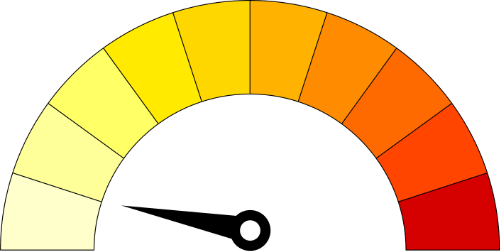
Let’s just say you have 99% of the book which is pretty understandable, and 1% which is weird.
Regarding the 99% bit, there are indeed some aspects of fantasy that are unusual, such as the Shinigami and the realm they inhabit, but the story itself isn’t hard to grasp. Well, the train of thought and reasoning is complex, psychologically dense and hard to follow at times, but not due to being weird. I would place it in the same category as mangas like Bleach or Noragami. Fantastic, unusual elements – yes. Surreal, magical realism elements – not really. Thus, there are little symbolic and/or strange elements that could make Death Note bizarre or ambiguous.
Now, the remaining 1% refers to the finale. Obviously, I cannot tell you how the book ends without spoiling it for you, but even though you will have a sense of satisfaction when the story is concluded, the mystery is definitely prolonged in a way that is very much opened to interpretation.
Here in Mindlybiz, Death Note gets a score of 0.5 in the Bizarrometer.
Leave a comment
Add Your Recommendations
Popular Tags