







The Longest Journey has been on my very long list of to play for the past 25 years. Numerous online forums recommended it as a bizarre and memorable gaming experience, and they were not wrong. The Longest Journey is an epic and strange adventure, with a bold concept and a most unexpected female-only protagonist.
I had previously played Syberia, an adventure point-and-click game also featuring a female lead, which I loved. Knowing it would be bad idea to start comparing games, I decided not to read much about The Longest Journey, going in completely fresh, without any assumptions or expectations.
Review
April Ryan, a teenage art student living in Newport, wakes from a very vivid and unsettling dream – only to discover that it wasn’t a dream at all. April learns of the existence of a parallel world called Arcadia, filled with mythical beings and magic, a stark contrast with the modern, technology-driven Earth she inhabits. Reality as she knows it is slowly being disrupted, as the fragile balance that separates the two worlds begins to weaken. Her rare connection to both places puts her at the center of a growing conflict over the precarious balance that maintains the separation between the two worlds. As the game progresses, April gradually uncovers hidden truths, forcing her to come to terms with her own identity and sense of belonging.
The Longest Journey was a surprisingly enjoyable game. The protagonist, April Ryan, was quirky and funny. She often joked about her love life (or lack of it) and had no compulsion about ridiculing herself through self-deprecating humour. Although some jokes were a bit silly, I thought April was a strong-willed character. Not many games prior to 2000 featured a female protagonist, so I found the choice of a feisty young lady with a turbulent childhood as the playable character in an epic saga like The Longest Journey pretty awesome and progressive for its time.
I was also happy to see that the writers did not turn this into a love story. With so many hints about April’s unsuccessful love life, I was expecting a cliché encounter with some prince of Arcadia, but was happy to be proved wrong. Instead, April’s journey is a personal one, focused on her struggles, her identity and her destiny. The fact that April isn’t some kind of powerful being waiting to awaken her latent powers makes the story all the more compelling. April is a simple student, with simple friends, trying to make a living just like the rest of us, which makes it easy to immediately connect with her.
And, man, how incredible April’s voice sounded! Sarah Hamilton has, hands down, one of the best voices in video gaming, in my opinion (Andrew Donnolly, who voiced Burns Flipper, was also excellent).
Now, it is inevitable to make comparisons with other point-and-click adventure games. And, honestly, compared to classics such as Monkey Island, Broken Sword and Gabriel Knight, I felt The Longest Journey’s dialogue-to-puzzle ratio was much higher, and the overall quality of the puzzles was inferior. In my opinion, most of the puzzles in The Longest Journey were very basic, with some notable exceptions as I describe below.
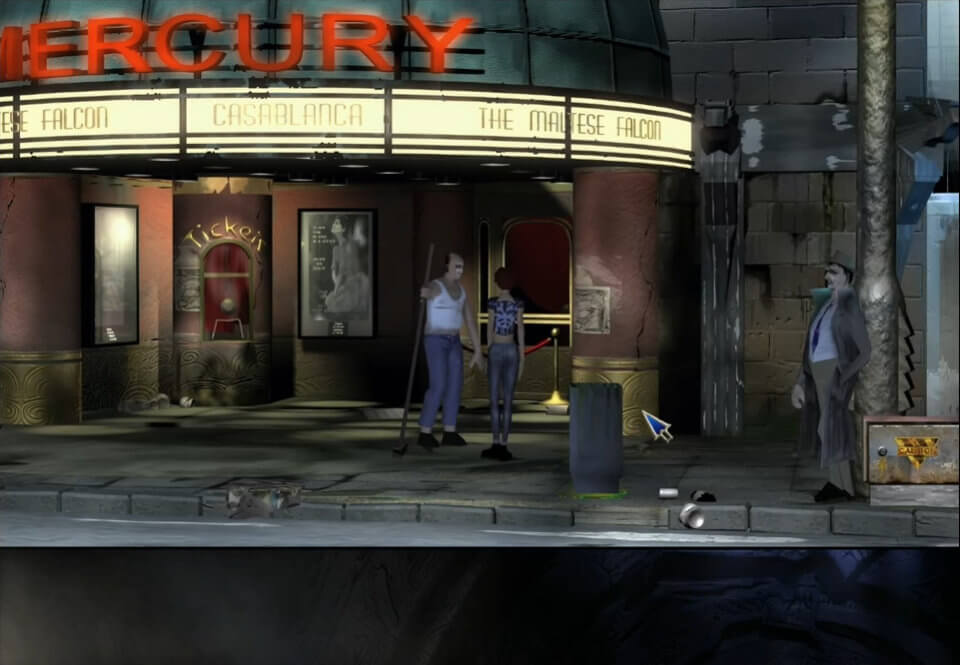
Because game uses pre-rendered 2D backgrounds with static camera angles, and limited interactions (usually around two to three clickable elements), there isn’t a lot you can do or explore. Trial and error is, in most cases, an effective strategy due to the limited number of items and actions available to the player. This is not a criticism in itself, as I was quite happy not to spend hours roaming helplessly in search for tiny clues. However, when very simple puzzles are combined with a limited foraging area and restricted actions, solving them is unlikely to provide a real sense of fulfillment.
That said, although there were a few challenging puzzles that were genuinely fun and required logic thinking to solve (for example, the statue puzzle in Chapter 8), other puzzles were, how should I put it, … just silly.
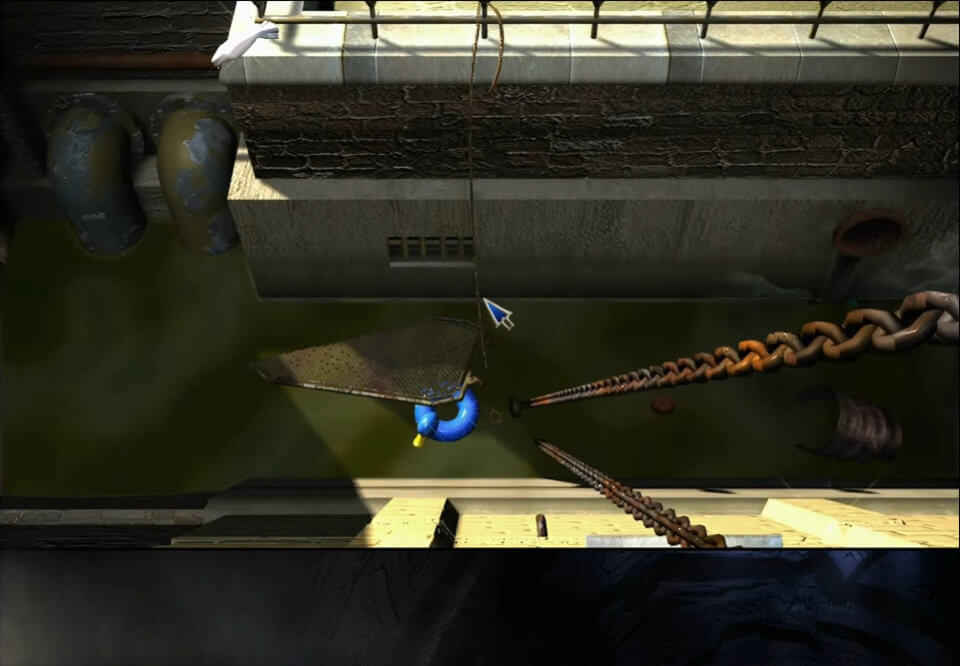
For instance, in Chapter 2 April is supposed to acquire a key hidden on a subway rail track (if you haven’t played the game you might want to skip this paragraph as I will mention the solution to this puzzle). In order to get it, however, she must first obtain a rubber duck. Yes, a rubber duck! Conveniently, one is floating in the canal just below her room’s window, but, alas, it is stuck on a crate. So what is the logical thing to do? My thoughts exactly. Scatter some breadcrumbs on the rubber duck to attract a seagull, which then lands on the crate and releases the rubber duck. Next, April should find the rubber duck floating, well … somewhere, and grab it. But wait, why a rubber duck? Well, it’s obvious! Inflate it and attach it to a clamp to keep the clamp open. Then, remove a plaster from the rubber duck so that it slowly deflates. Finally, attach a clothesline to the clamp and use the whole contraption as a fishing rod to retrieve the key as the rubber duck deflates and the clamp closes. You see – simples!
You might think I’m trying to be funny, but I’m really not. Those are literally the steps required to solve one of the puzzles in order to progress in the game.
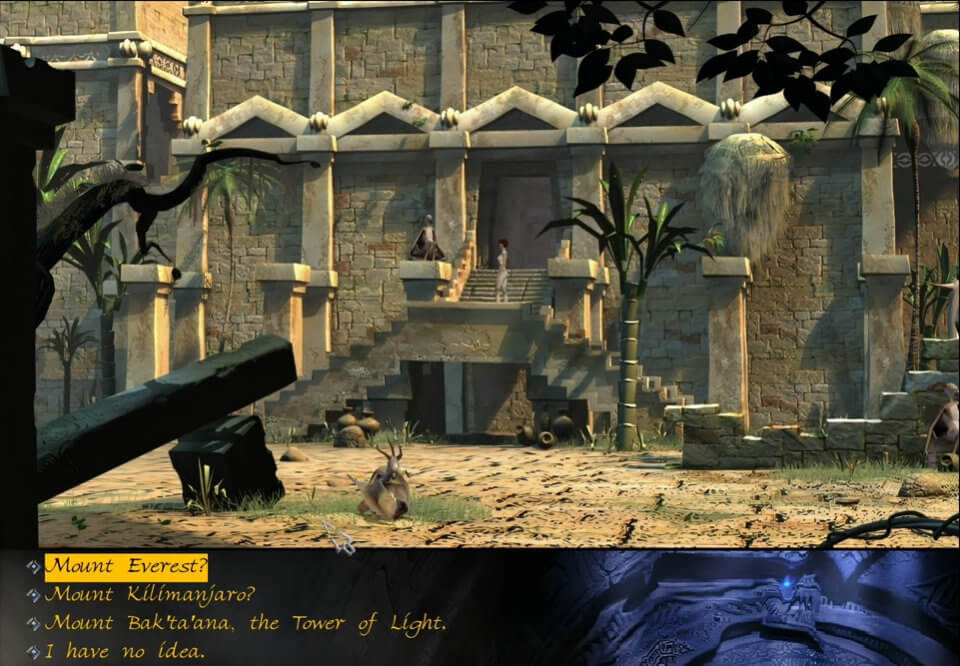
Other potentially interesting puzzles ended up being a disappointment. In Chapter 8, April is required to pass a test about four tales of the Alatiens. I was genuinely engaged in learning about the different tales, hoping that my knowledge would actually be put to the test. To my chagrin, the answers are effectively given to you on a plate. For example, one of the questions asks: “In the Tale of the Winds, which mountain did Iuana fall from in her vain attempt to fly higher and further than anyone else?”
The possible answers are:
- Mount Everest?
- Mount Kilimanjaro?
- Mount Bak’ta’ana, the Tower of Light.
- I have no idea.
This really flopped as a puzzle really. At the very least, the first two options should not have been presented as questions, even if it is obvious they are intended as jokes.
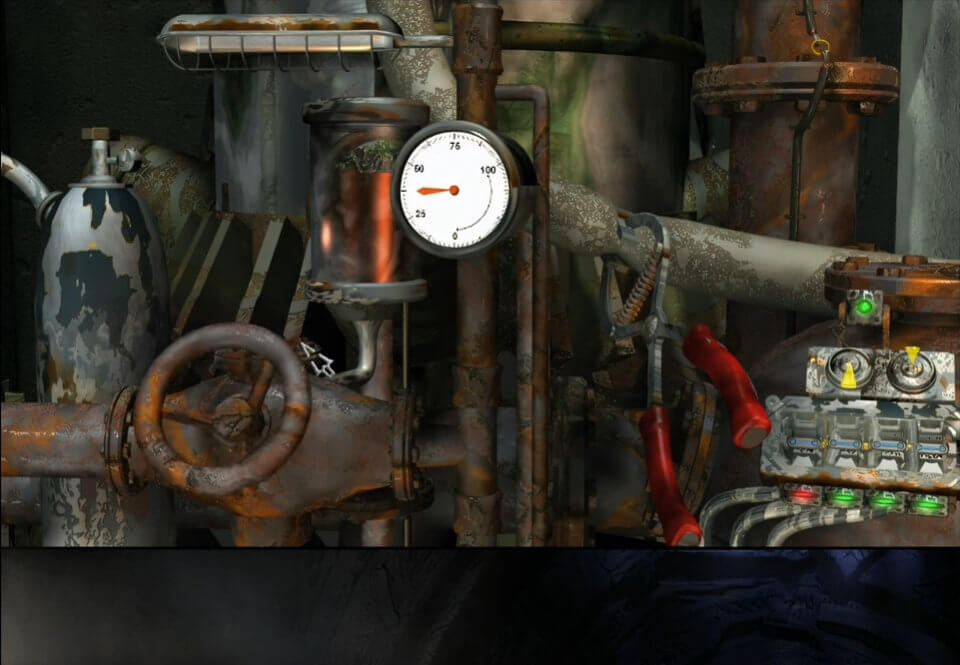
Some puzzles oftentimes assume knowledge that may not be obvious to every player (again, skip this paragraph if you don’t want to know the solution to these puzzles). For example, in Chapter 2 you need to understand that metal conducts electricity in order to realise that the ring can be used as a bridge between wires (even if not scientifically accurate – the ring would most likely cause a short circuit or even melt if the current were strong enough). Similarly, when you play the game of cups, in which you guess under which cup a coin is hidden, you are supposed to know that some screwdrivers are magnetic and can attract objects made of iron, steel or nickel. Incidentally, the coins in the game are likely gold, so even if the screwdriver were magnetized, it wouldn’t have any effect on them – yes, I know, I’m being a nerd.
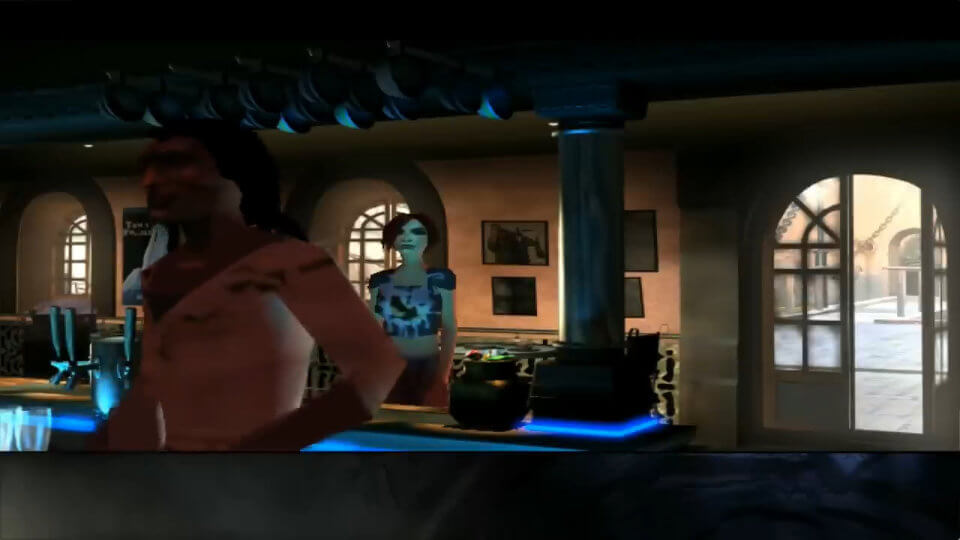
The graphics looked pixelated, which is unsurprising given that the game is from 1999. However, compared to contemporaneous games like Gabriel Knight 3 (released the same year), I felt the graphics were weaker overall, including the cutscenes. In addition, there were quite a few bugs, such as the half-complete policeman at the lift to the upper levels of Newport, or April’s ability to pass through objects and people.
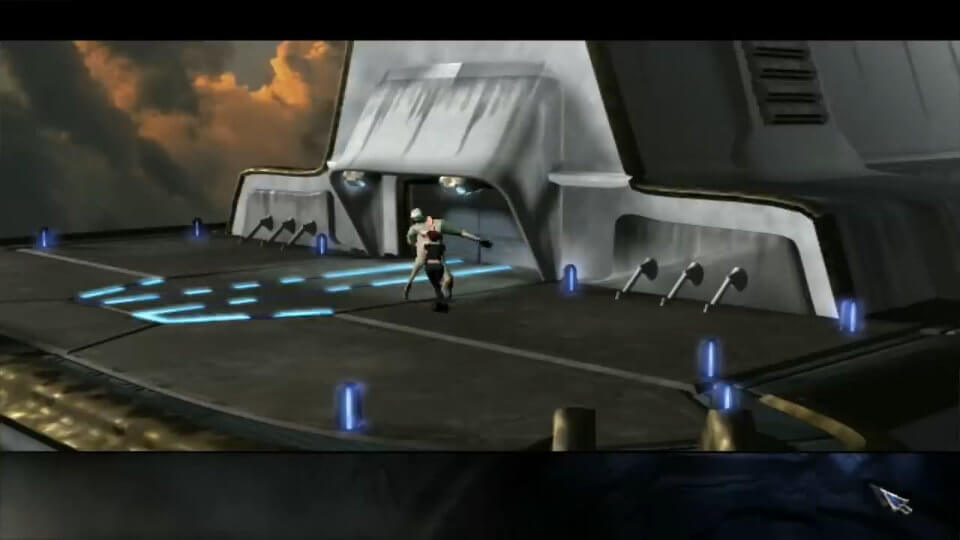
There are also no game overs, so April cannot really die in the game. This was an interesting concept, and understandable, since puzzle games are primarily about logic rather than dexterity with the joystick. However, I think this aspect removed an important thriller component from the gameplay. In other point-and-click adventure games, there are situations where you must complete a task within a certain period, or your character dies. In The Longest Journey, April can never fail or die. So, when the monster came after her in Chapter 12, I simply ignored it and continued searching for clues, as there was no consequence to the monster getting close. The same applies to the Vanguard Agent attempting to knock down April’s room door: you can take as much time as you need examining your surroundings, since the agent will never get inside. In my view, it wouldn’t have hurt to add a bit more suspense to the gameplay by allowing the character to die in certain situations.
But I wanted to end this review on a very positive note, so I saved the best for last: the story. Wow, how The Longest Journey hasn’t yet been adapted into a TV Series or graphical novel is baffling! The potential is immense. It has adventure, suspense, drama, science fiction, humour, and a touch of weirdness, all packed into a cohesive and highly engaging story – if you like epic fantasy, of course.
The story is rather complex though. April finds herself between the two parallel worlds: Stark, a futuristic, technology-driven Earth, and Arcadia, a magical realm, each with its own political and societal structures. Because it is an original story, you not only need to familiarize yourself with the many characters, races, magical objects, mythical beings and history of Arcadia, but also understand the origin of the schism that split the two worlds apart. It’s a lot to take in, believe me.
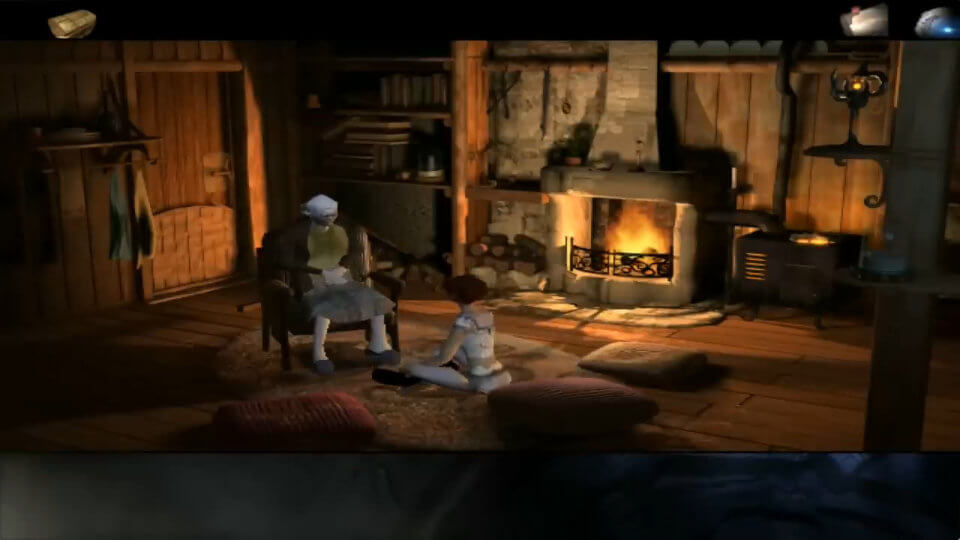
That said, this multi-layered story is packed with exceptionally memorable scenes. One that stood out for me was April arriving at old Lady Avane’s home in the “Between, and Everywhere” realm. That was brilliant, because instead of going for the predictable flashy, geometric, and bizarre visuals, the game creators opted to represent the between-worlds realm as a cozy grandma’s house. Neat!
I’m well aware that The Longest Journey saw two spin-offs materialise, Dreamfall and Dreamfall Chapters, while a direct sequel called “The Longest Journey Home” has also been considered (although it will likely never happen). I haven’t played the spin-offs – probably will at some point – but I’m not sure how I feel about a direct sequel. I get it, most of us became attached to a relatable and lovable character like April, and, let’s face it, the story just begs for a continuation. Where did April go after leaving the Guardian’s Realm? Did she reconcile with her family and friends? Did she ever visit Arcadia again, now that she can shift at will? Who is the mysterious Lady Alvane? Why are we seeing an aged Crow but not April?
I guess Dreamfall will answer some of these questions, but I’m happy keeping my own version of April’s story to myself – my personal ending, as it were.
Star rating
At the turn of the millennium, The Longest Journey faced the seemingly impossible task of keeping up with video-game giants like Monkey Island and Broken Sword. In my opinion, it rose to the challenge like a champ! I had immense fun playing April Ryan, a charismatic, interesting and relatable character, beautifully voiced by Sarah Hamilton. Even after more than 40 hours of gameplay, I admit I felt a tinge of sadness when I had to say goodbye to this incredible game.
Could the game have been improved? Definitely. The puzzles were a mixed bag in terms of entertainment and difficulty, the graphics were subpar even for the technology of the time (the character models were particularly weak), and some gameplay decisions were a bit of a downer (e.g., absence of time limit on certain tasks). But storywise, The Longest Journey is unparalleled. With its combination of genres – fantasy, science fiction, drama, mystery and comedy – the game will appeal to most gamers.
Here, at Mindlybiz, The Longest Journey gets a star rating of 3.5.
Bizarrometer
Because the story is complex and multi-layered, you may feel overwhelmed by the sheer amount of details introduced as you play. Remember, it’s an original story, so you will need to get accustomed to the complex world-building and everything that comes with it. What I found really helpful were April’s diary entries, as she summarises the important events within each chapter.
The game is not devoid of bizarre elements, either. There are some pretty surreal cut-scenes right in Chapter One. In fact, the realms visited by April, and the characters that dwell within them, are strange in their own right; though perhaps along the lines of The Neverending Story-type fantasy rather than Pan’s Labyrinth-type fantasy.
One of the weirdest elements in the story, for me, was the relationship between Lady Alvane and April. By the end of the game, I personally concluded that they might be one and the same person, though that is just my interpretation. In fact, the story leaves much ambiguity regarding April’s fate, which I appreciated (though I suppose some of it will be clarified in Dreamfall).
The Longest Journey receives a bizarrometer score of 2.5.
Leave a comment
Add Your Recommendations
Popular Tags