
Kafka on the Shore Explained!
While perusing Murakami’s website for information about Kafka on the Shore, I spotted a reading group guide that contained 14 questions related to the novel. I decided to try to answer all of these, in the hopes that it may help shed some light on some of the characters/events in the novel.
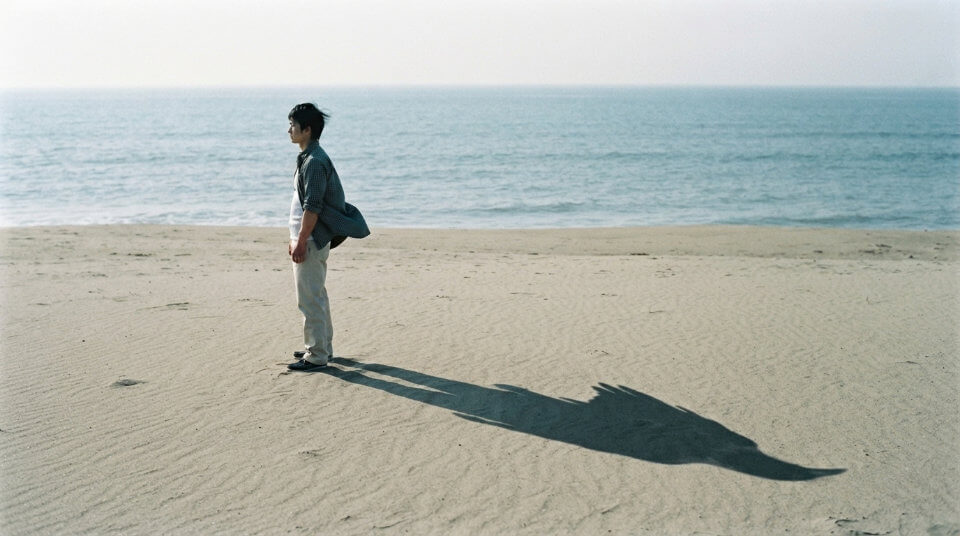
1. The first character to speak in Kafka on the Shore is the “boy named Crow” [p. 3]. Who is he? What part of Kafka Tamura’s psyche does he represent?
The “Boy Named Crow” (Crow from now on) is first and foremost Kafka’s inner voice. In many cultures, crows symbolise inner wisdom, the brakes in our impulsive actions, allowing us to evaluate and steer us towards the right course of action. Crow is, therefore, an archetypal image that is summoned whenever Kafka’s mind is imbalanced.
Crow specifically appears when Kafka is in situations of duress, danger or anxiety. For instance, he shows up when Kafka prepares to run away from home, and advises him to be tough and strong. It also appears when Kafka wakes up covered in blood and freaks out, but Crow manages to calm him down, encouraging him to think logically.
Just as Jungian archetypes may be called upon in situations of need, so is Crow summoned when Kafka is experiencing overwhelming emotions that cloud his judgement, offering him insights from deep inside his subconscious that Kafka is unaware he possesses.
So, Crow is there to let Kafka know about his insecurities and “edge him forward” to overcome them. This is very similar to Jungian archetypes, such as the Hero or the Sage archetypes, which serve a similar purpose in our psyche. Furthermore, in Japanese mythology, the crow is often associated with guidance, most famously through Yatagarasu, who appears in the stories when someone needs to be led towards the right path.
But that’s not the whole story. Crow cannot simply be a figment of Kafka’s imagination, because Crow is seemingly detached from Kafka, while the latter enters the forest close to the end of the novel. Moreover, Crow transforms himself into a literal crow to fight Johnnie Walker, an evil spirit who wanders the limbo, after being released by Nakata (see below). This is significant because it means that Crow is both part of Kafka’s psyche, but also an independent concept outside Kafka’s mind.
My take is that Crow is actually the spirit of Miss Saeki’s dead lover. Miss Saeki abandoned Kafka at the precise moment Crow was born. As I describe in greater detail in question 9, it is likely that Miss Saeki realised that her son held the spirit of her dead lover, and this was too painful for her to deal with, so she abandoned Kafka.
2. “Kafka,” we later learn, means “crow” in Czech. What relationship is Murakami trying to suggest between Franz Kafka, Kafka Tamura, the boy named Crow, and actual crows? At what significant moments do crows appear in the novel? What symbolic value do they have?
Crows are known for their incredible resilience and adaptability, thriving in various environments such as forests and cities. They are very intelligent creatures, and have been shown to be able to use and even make tools (e.g., they drop nuts onto roads so that cars crack them open 😊). Their adaptability is actually one of the reasons they are found pretty much across the world. Crows also lead rich social lives, and have excellent memory.
Kafka’s actual name is not known. He chose Kafka because it means “crow” in Czech. In the novel, Kafka feels hopeless, aimless, and often voices his wish to become more capable, independent, and strong… like a crow. Indeed, crows are depicted in the novel as “dauntless” and “strong”: “Nobody’s going to help me. At least no one has until now. So I have to make it on my own. I have to get stronger – like a stray crow. That’s why I gave myself the name Kafka.”
The caws of crows are heard when Kafka is unsure which path to take, or is putting himself in potentially perilous situations. For instance, check out this passage:
“What makes sense, what doesn’t, it’s all mixed up. Above me, a crow gives out a piercing caw that sounds like a warning, it’s so jarring. I stop and cautiously survey my surroundings.”
Also, crows fly back to their nests and a crow caws after Kafka and Miss Saeki have sex, and just before Kafka dream-rapes Sakura, he hears a crow squawking: “The crow squawks loudly. I look up, but I can’t spot the bird. I can’t even see the sky. […] Again the crow cries out, sending me a message, but I can’t work out what it’s trying to tell me”.
Finally, as Kafka ventures into the forest, he notices: “Above me, a crow gives out a piercing caw that sounds like a warning […] The crow squawks shrilly again – the same bird as before, sending the same message.”.
In all these events, crows appear to be sending Kafka warning signals, when he is undergoing an extreme emotional reaction, and/or is about to behave in a way that goes against his better judgement.
In addition, Kafka named his inner voice “The Boy Named Crow”, Crow (see question 1), and often feels that Crow is stronger than him, seeking his advice when facing stressful situations or needing to make difficult decisions.
The connection to Franz Kafka is more subtle. In “In the Penal Colony”, Franz Kafka provides technical details of an execution machine (e.g., how the gears work, how the body is positioned, etc.), which Oshima probably interprets as a metaphor for human existence. To Kafka Tamura, however, Franz Kafka often devises worlds with bizarre rules and laws so that we feel what it is like to live in a cruel and incomprehensible system. Thus, just as the man in In the Penal Colony is confused and does not understand why the system is built the way it is or whether he deserves punishment, so is Kafka also confused about the meaning of his life and whether he deserves the punishment he perceives he is receiving. In this sense, Kafka Tamura is experiencing his own life as if he were inside Kafka’s machine.
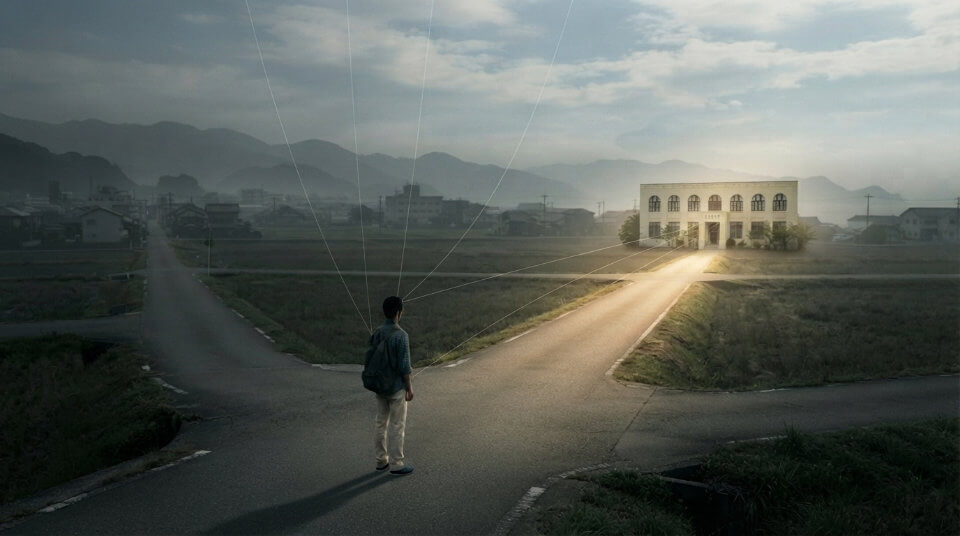
3. When Kafka meets Sakura on the bus, they agree that “even chance meetings . . . are the results of karma” and that “things in life are fated by our previous lives. That even in the smallest events there’s no such thing as coincidence” [p. 33]. What role does fate, or meaningful coincidence, play in the novel? Is it karma that determines Kafka’s destiny?
Kafka is worried that the Oedipal curse prophesied by his father (that Kafka will sleep with his mother and sister, and kill his father) will come true, so he desperately tries to escape this fate by running away from home towards an unknown destination.
In chapter 41, the boy named Crow says:
“That curse is branded on your soul even deeper than before. You should realise that by now. That curse is part of your DNA. You breathe out the curse, the wind carries it to the four corners of the earth, but the dark confusion inside you remains. Your fear, anger, unease – nothing’s disappeared. They’re all still inside you, still torturing you.“
That sounds as if a mechanism is hidden within Kafka’s DNA, an omen that Kafka cannot escape. The way I see it, the omen is karma, which stays with him wherever he goes, whatever he does.
So, yes, Kafka’s destiny is partly determined by karma. As described in greater detail in question 9, Miss Saeki’s dead lover’s spirit inhabits Kafka, which is influencing and guiding Kafka on his own path of self-discovery.
According to this view, Kafka’s encounters with Sakura and Miss Saeki are not pure coincidences. For example, Kafka goes on a random journey from Nakano, drawn to a small library in Takamatsu, a 10-hour drive from his place, which happened to be exactly where Miss Saeki – very likely, his biological mother – works. In parallel, Nakata, who is spiritually connected to Kafka, goes on a blind drive across Japan just to arrive at the same exact library without knowing why – as if invisible forces were marionetting the characters around – helping Miss Saeki depart from this world so that she can help Kafka complete his journey of self-discovery.
Another passage that corroborates the idea that fate is something predetermined, that characters cannot escape, is given by the conversation between Nakata and Miss Saeki. Nakata asks her whether she knows about the entrance stone, to which Miss Saeki remarks:
“Yes, I do,” she said. […] “I happened to come across it a long time ago. Perhaps it would’ve been better if I’d never known about it. But I had no choice in the matter.”
This is yet another clue that characters in Kafka on the Shore are all bound by fate. It’s like they are born with a predisposition (the DNA mechanism mentioned above) that is programmed to be realised, which is kind of in line with the philosophical stance of determinism that I explained here.
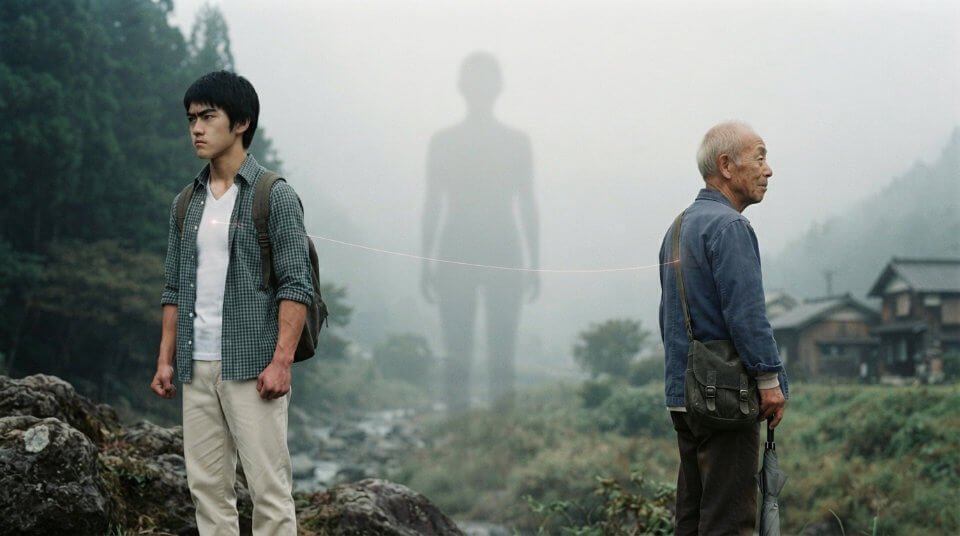
4. Much of the novel alternates between Kafka’s story and Nakata’s. What effects does Murakami create by moving the reader back and forth between parallel narratives? What is the relationship between Nakata and Kafka?
It is important to note that during the first half of the novel, Nakata’s storyline lags behind Kafka’s. This becomes especially obvious when you realise that Nakata’s murder of Johnnie Walker (Chapter 21) and Kafka waking up covered in blood on the grounds of the shrine (Chapter 9) happened on the same night – Wednesday, May 28th. Likewise, the intense thunderstorm that appears to signal the opening of the entrance happens in Chapter 32 and Chapter 25 for Nakata and Kafka, respectively. Only by about Chapter 38 do the events of Nakata and Kafka catch up, when Nakata and Hoshino arrive at the library while Kafka hides in Oshima’s cabin.
It is interesting that by alternating between Nakata and Kafka’s storylines, Murakami establishes a direct link between the two seemingly unrelated characters, with no family ties or even a suggestion that they have met in the past, and they never actually meet in person.
However, it is clear they appear to share some astral connection. For instance, Nakata killed Johnnie Walker due to the influence of a foreign consciousness that made him act against his wishes. After murdering Johnnie Walker, Nakata loses consciousness and wakes up surprised that neither his hands nor clothes are covered in blood. Kafka, on the other hand, wakes up in a shrine covered in blood on the same night Nakata kills Johnnie Walker (Wednesday, May 28th) without any memories of what had happened. Later, he acknowledges the possibility that he killed his father, as he confesses to Oshima that he might have murdered him in a dream.
Note the strategic placement of Chapter 9 (Kafka waking up covered in blood in the shrine), after Chapter 8, where we get to know Dr. Tsukayama’s theories regarding the soul-body duality. Here, we learn that during the Rice Bowl Hill incident, several children lost consciousness for several minutes and looked as if their minds had been disconnected from their bodies. This is a first clue that consciousness can be momentarily separated from the physical body. The respected scientist Dr. Tsukayama mentioned in an interview that Nakata’s mind wandered out of his body, as if it were a simple “container”. He also paralleled the incident to Japanese folk tales involving spirit projection, where “the soul temporarily leaves the body, goes off a great distance to take care of some vital task and then returns to reunite with the body”. Importantly, he notes that as long as the will is strong enough, the soul is able to separate from the body even when humans are alive.
Also note that after the Rice Bowl Hill incident, Nakata’s mind was wiped clean. This could mean that his mind was essentially rebooted, allowing other minds/spirits to possess him. In other words, it turned Nakata into a sort of a “vessel”, whose purpose later becomes to enable Kafka’s unconscious to be expressed.
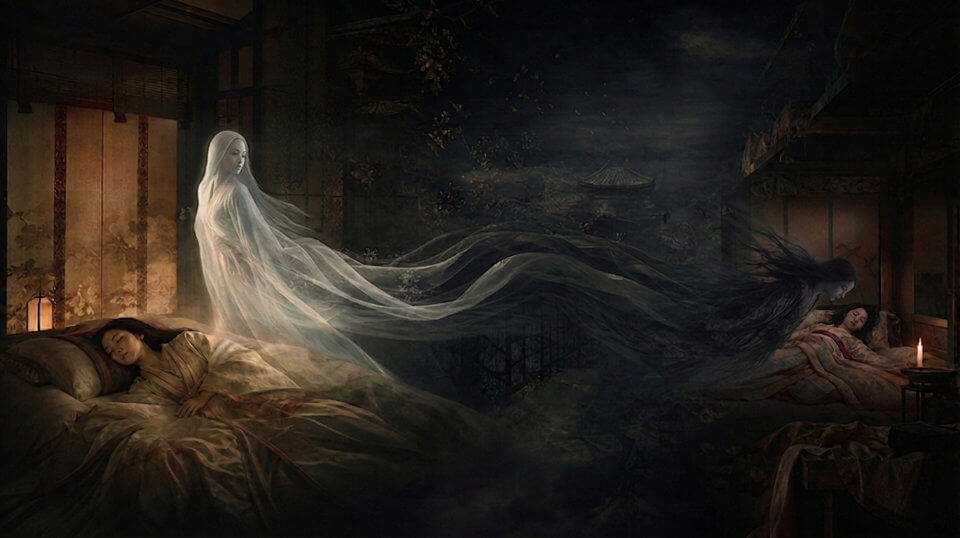
Oshima also describes something along these lines. In Chapter 23, he tells Kafka about the Tales of Genji, in which Lady Rokujo, one of Prince Genji’s lovers, unwittingly turned into an evil, living spirit during her sleep which possessed and killed Lady Aoi (Prince Genji’s wife). Lady Rokujo had travelled through space from her subconscious into Lady Aoi’s bedroom, later waking up without being aware of any of it. Importantly, Oshima mentions that living spirits emerge from negative emotions, and usually are unconsciously summoned to perform some “negative” action.
Now, Kafka’s father, a famous sculptor named Koichi Tamura, was found stabbed in a pool of blood in his home on the day after the Johnnie Walker incident. What’s more, the incident with Johnnie Walker seemingly happened in Nakano Ward, where Kafka’s father lives. To me, this indicates that Johnnie Walker and Kafka’s father are presumably the “same” person, strongly suggesting that Kafka’s living spirit left Kafka’s body and entered Nakata, who then killed Johnnie Walker/Kafka’s father (the negative action).
Still, the above doesn’t answer the question: why are Nakata and Kafka connected at all? My interpretation is that they are connected via a masterplan concocted by Johnnie Walker. When 15-year-old Miss Saeki opened the entrance stone, Kafka’s father got struck by lightning, causing him to nearly die. The evil spirit Johnnie Walker, inhabiting the limbo and wishing to enter the physical world, got stuck (unintentionally?) in Kafka’s father (see question 9). Johnnie Walker appeared to know Crow, who inhabits Kafka, and I suspect he also played a major role in Miss Saeki’s meeting Kafka’s father. In any case, Johnnie Walker set up a prophecy that Kafka would eventually kill his father, which would ultimately release Johnnie Walker. He only needed an empty vessel that could take in Kafka’s spirit and perform this “negative action”: that empty vessel is Nakata. Johnnie Walker says so when he meets Nakata:
“I’ve been looking for someone like you for a long time […] But it wasn’t easy to find the right person. The other day, though, I saw you talking to a cat and it hit me – this is the very person I’ve been looking for. That’s why I’ve had you come all this way.”
You might wonder why Johnnie Walker didn’t simply kill himself if he really wanted to die to access the limbo. But, apparently, death by suicide is not an option:
“And taking my own life isn’t an option. That’s already been decided too. There’re all sorts of rules involved. If I want to die, I have to get somebody else to kill me. That’s where you come in. I want you to fear me, to hate me with a passion – and then eliminate me”
Interestingly, Nakata and Kafka never meet in the novel, but they are somehow connected, since Kafka is able to unconsciously pass on his living spirit to Nakata. This is likely because of a prototypical memory (or shared consciousness; see question 8) that allows the transfer of spirits between individuals. Nakata effectively becomes part of Kafka’s “spirit network”, with Johnnie Walker acting as a mediator.
This interpretation effectively establishes the Nakata–Kafka connection.
The ultimately goal of Johnnie Walker: physical or spirit world?
“Do you know what limbo is? It’s the neutral point between life and death. A kind of sad, gloomy place. Where I am now, in other words – this forest. I died, at my own bidding, but haven’t gone on to the next world. I’m a soul in transition, and a soul in transition is formless. I’ve merely adopted this form for the time being.”
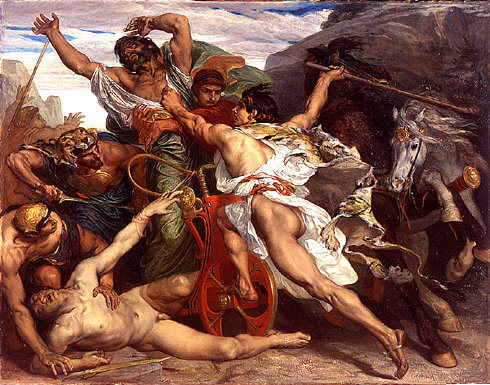
5. When Kafka is a young boy, his father tells him: “Someday you will murder your father and be with your mother” [p. 202], the same destiny as Oedipus. Kafka’s father also tells him that he will sleep with his sister and that there is nothing he can do to prevent this prophecy from being fulfilled. How do Kafka’s attempts to escape his fate bring him closer to fulfilling it?
One thing is clear: Kafka is so afraid of the prophecy laid out by his father that every girl and woman he feels attracted to is his potential sister or mother, respectively.
Pay close attention to what I wrote there, “every girl and woman he feels attracted to”. This “feels attracted to” is of fundamental importance, because emotional attraction is the prerequisite for the Oedipal complex to be expressed. That happens when Kafka meets Sakura and as soon as he feels attracted to her, the immediate thought that crosses his mind is whether she might be his sister. Likewise, Kafka is immediately attracted to both the younger and older Miss Saeki, thinking immediately that she might be his mother.
There are at least two arguments one could make that would lend support to the theory that Miss Saeki is Kafka’s mother. First, Kafka’s father had been struck by lightning, and Miss Saeki did write a book about survivors of lightning strikes. Given they were both in the exact same town, and given that not many people have been hit by lightning, Kafka reasonably concludes that Miss Saeki and Kafka’s father must have met during her research. Furthermore, Miss Saeki acknowledges that Kafka looks familiar, and 15-year-old Miss Saeki later admits to being his mother when they are both in the shared consciousness.
And all this is somewhat confirmed by Oshima’s conversation in Chapter 21. He mentions that when people attempt to avoid fate, it usually brings them closer to what they wanted to avoid in the first place. He gives the examples of Greek tragedies such as Oedipus Rex, in which Oedipus fulfils the prophecy of murdering his father and marrying his mother, despite his valiant efforts not to go in that direction.
While I believe there is a strong case for Miss Saeki being Kafka’s mother, whether Sakura is Kafka’s actual sister is far less clear. She seems to acknowledge she is not her blood-related sister: “I’m your sister, and you’re my brother. Even if we’re not blood-related, we’re most definitely brother and sister. You understand what I’m saying? We’re part of a family”. Still, note that Kafka had an older adopted sister (not blood-related), and Sakura says she is visiting relatives in Takamatsu (related to Miss Saeki perhaps), and also she has a brother she has not seen in quite a long time and says that she ran away from home when she was about Kafka’s age.
So, it is in this sense that Kafka’s attempts to escape his fate bring him closer to fulfilling it. He desperately tried to escape his father’s curse, of murdering him and sleeping with both his mother and sister, but ended up fulfilling it in a sense – it did not completely happen, since he presumably did not actually have physical intercourse with either Miss Saeki nor Sakura (it appears to have been during dreaming). In Chapter 31, Kafka and Miss Saeki do appear to have actual intercourse in reality, but again to Kafka the experience was similar to that of a dream, and the narration changed from Kafka’s first person to second person, Crow’s perspective, before sex, suggesting that the sex was really between Miss Saeki and the spirit of her dead lover (see also question 9).
There is also Crow’s interesting monologue at the beginning of the novel where he says:
“Sometimes fate is like a small sandstorm that keeps changing direction. You change direction, but the sandstorm chases you. You turn again, but the storm adjusts. Over and over you play this out, like some ominous dance with death just before dawn. Why? Because this storm isn’t something that blew in from far away, something that has nothing to do with you. This storm is you. Something inside you. So all you can do is give in to it, step right inside the storm, closing your eyes and plugging up your ears so the sand doesn’t get in, and walk through it, step by step. There’s no sun there, no moon, no direction, no sense of time. Just fine white sand swirling up into the sky like pulverised bones. That’s the kind of sandstorm you need to imagine.”
So, again, Murakami is pointing to the idea that fate is not something you can run away from – it is actually imprinted in your genes, such that it will be expressed no matter what (see also question 3).
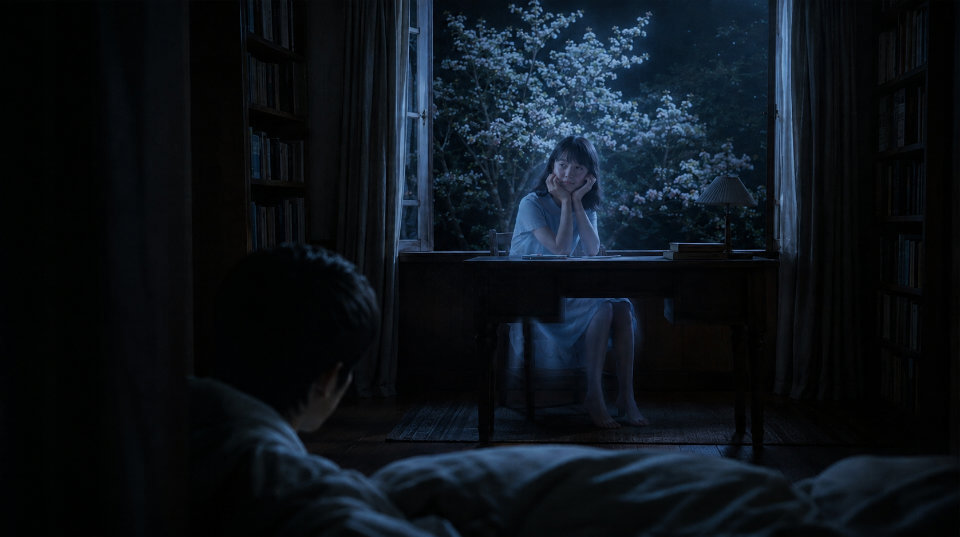
6. The phrase “for the time being” is repeated throughout Kafka on the Shore. Why has Murakami chosen to use this qualifying statement so often? How is the conventional concept of time stretched and challenged by events in the novel? Why does Miss Saeki tell Kafka: “Time’s rules don’t apply here. Time expands, then contracts, all in tune with the stirrings of the heart” [p. 219]?
(One small correction: Miss Saeki does not say “Time’s rules don’t apply here. Time expands, then contracts, all in tune with the stirrings of the heart” to Kafka. It is actually Kafka who is thinking about it when he sees the spirit of 15-year-old Miss Saeki for the first time)
The most significant passage in the novel where time is given special relevance is when Kafka encounters the two Japanese soldiers in the forest (the limbo), who tell him:
“For the time being, you’re supposed to stay here till you get settled,” the brawny soldier says. “It won’t be for that long. For the time being.” “As I said before, time isn’t much of a factor here,” the tall one says. The other one nods in agreement. “Not a factor at all.”
So the place where Kafka meets the two soldiers is not a physical place where the concept of time as we know it exerts any influence. Rather, it is a spiritual place where the laws of physics don’t really apply, so the concept of time becomes meaningless.
This is also relevant to the interaction between Kafka and 15-year-old Miss Saeki:
“Miss Saeki’s life basically stopped at 20 when her lover died. No, maybe not at 20, maybe much earlier … I don’t know the details, but you need to be aware of this. The hands of the clock buried inside her soul ground to a halt then. Time outside, of course, flows on as always, but she isn’t affected by it. For her, what we consider normal time is essentially meaningless.” “Meaningless?” Oshima nods. “As if it doesn’t exist.” “What you’re saying is that Miss Saeki still lives in that frozen time?”
Interestingly, there is a double meaning here: Oshima probably means that Miss Saeki lives in a frozen time in a figurative way (like, she lacks motivation and will to live such that she cannot think ahead to a future). However, she also literally still lives in that frozen time, since her 15-year-old spirit is a permanent resident of the spiritual world (i.e., limbo).
And it is interesting that Kafka sees the spirit of 15-year-old Miss Saeki as if she were visiting his reality. But what Kafka is really experiencing is the crossing between worlds, which is why it feels to him like it is all a dream and time is stretching – it is not yet limbo, but not exactly reality either (see also question 7).
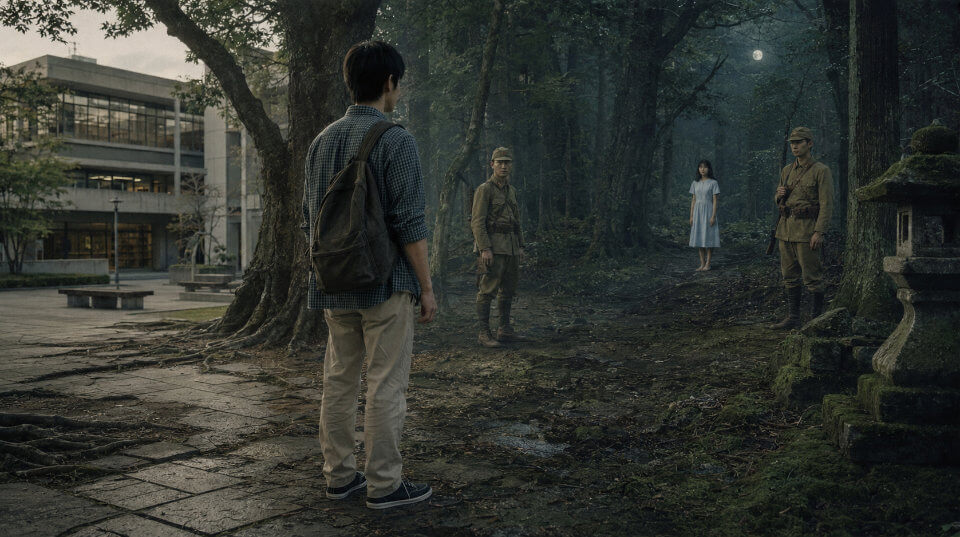
7. In what ways are the boundaries between past and present, dreaming and waking, fantasy and reality blurred and often erased in Kafka on the Shore?
The boundaries between past and present are most obvious when Kafka enters the forest and the concept of time is meaningless. He sees the spirits of WWII soldiers and of 15-year-old Miss Saeki as if they were bone and flesh. As explained in question 8, this is actually happening in a sort of shared consciousness, where the rules of time don’t really apply, so past and present both exist at the same time.
One perfect example of the blurring of dreaming and waking is the sex scene between Kafka and Miss Saeki. Kafka wakes up to see a sleepwalking Miss Saeki getting undressed and into bed with Kafka. While they are having sex, Kafka has the feeling as though as if he’s struggling to find the border between dream and reality. He mentions the axis of time, that somewhere something weird is happening to time, and that reality and dreams are mixed up. Likewise, Kafka dreams of raping Sakura, even though that dream almost feels that Kafka is actual physically present.
The Nakata-Johnnie Walker scene is a case of fantasy blurred with reality. Nakata kills Johnnie Walker, who turns out to be Kafka’s father. But Kafka’s father doesn’t look like Johnnie Walker, and there is no indication that he was murdering cats (the news did not mention cat corpses in his home, only that he was stabbed and lay on pool of blood). So, the Johnnie Walker scene isn’t occurring in modern day Tokyo (i.e., in Kafka’s world), but rather in another world/reality.
The visits from the spirit of 15-year-old Miss Saeki that Kafka experiences are likewise happening at this crossing between reality and fantasy. More specifically, the spirit of 15-year-old Miss Saeki lives in the spirit world which can only be accessed once the entrance stone is opened – the spirit world can be accessed via a sort of shared consciousness (see question 8). However, Kafka is able to see the spirit of 15-year-old Miss Saeki in his own reality, just as Nakata can see Johnnie Walker in his own reality.
In a sense, there are two realms in Kafka on the Shore. Our own realm, present day Tokyo, and the realm of spirits, which the two WWII soldiers and 15-year-old Miss Saeki inhabit. What makes this interesting is the fact that these two worlds interact, which causes the blurring effect mentioned in the question.
8. The teacher in charge of the children who lost consciousness in the woods during World War II writes to her professor many years later and tells him: “I find the worldview that runs through all of your publications very convincing—namely that as individuals each of us is extremely isolated, while at the same time we are all linked by a prototypical memory” [p. 96]. How are the main characters of the novel—Kafka, Nakata, Oshima, Miss Saeki—“extremely isolated”? In what ways do they share a “prototypical memory”? What would that memory be?
I think this is the most critical question of the 14 questions posed here. Answering this question would essentially bring all the pieces together. But, perhaps not surprisingly, this is the most difficult question of all.
“Extreme isolation” can be interpreted in the context of the conversation between Oshima and Kafka in Chapter 3. Oshima explains that there is an ancient theory that categorised people into male/male, male/female, and female/female. Then God split people in two halves, such that the world was now divided into only male and female. Humans are destined to spend their entire lives searching for their missing half. So, everyone is isolated and incomplete because they have not yet found a soul that completes them.
Now, the “prototypical memory” is an even more fascinating idea. I interpret it as something akin to the collective unconscious idea proposed by Carl Jung. According to Jung, when we are born, our minds aren’t blank canvases. There is something fundamentally present in each and every one of us, imprinted in our minds like a memory of sorts. Jung called these imprints, archetypes, and he believed they are shared among human beings. So, we are all born with, and tap into, the same types of archetypes.
My interpretation is that the prototypical memory mentioned in Kafka on the Shore is a kind of fundamental pattern of human consciousness, enabling individuals to access to each other’s minds as spirits in propitious situations. The reason I lean towards this shared consciousness idea is because it must be possible for different consciousnesses (or spirits) to influence one another. The Tales of Genji that Oshima mentions in Chapter 23 are especially revealing in this respect:
“Lady Rokujo […] becomes so consumed with jealousy over Genji’s main wife, Lady Aoi, that she turns into an evil spirit that possesses her. Night after night she attacks Lady Aoi in her bed until she finally kills her. Lady Aoi was pregnant with Genji’s child, and that news is what inspired Lady Rokujo’s hatred. […] Completely unaware of it, she’d been flying through space and passing down the tunnel of her subconscious into Aoi’s bedroom”
Thus, the episodes in which Kafka unconsciously passes on his living spirit to Nakata, using him for murder, or, in the forest, when Kafka is visited by Miss Saeki’s spirit in his own mind (remember, the forest is likely Kafka exploring his own unconscious; see question 10) are all possible because of this shared consciousness network (i.e., the prototypical memory) that connects Kafka, Nakata, and Miss Saeki (and presumably others).
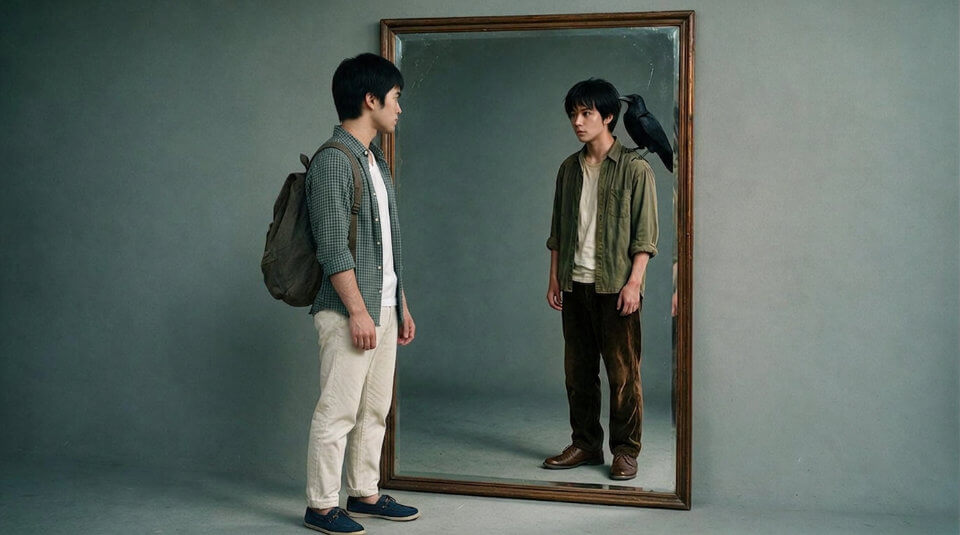
9. Kafka Tamura seems, in some mysterious way, to be both Miss Saeki’s son and the ghost of her long-dead lover. How does Murakami intend us to understand this shifting and apparently impossible dual identity?
As described in the response to question 11, in Kafka on the Shore, every human being is composed of two halves. Only when we possess both halves do we feel complete – missing half a shadow makes us feel lost in life and without a purpose.
With respect to Kafka, he possesses his own spirit – this is actually Kafka Tamura. Now, the other half of Kafka is the half-spirit of Miss Saeki’s dead lover. Because it is not “part” of Kafka, he sees it as an alter ego – that is The Boy Named Crow. This is the reason why Crow sometimes feels like he is just Kafka’s conscience, while at other times he feels like a separate entity from Kafka.
There is an obvious clue that Miss Saeki’s dead lover lives in Kafka. First, Kafka notices a painting of a 12-year-old Miss Saeki and her lover on the beach. When Miss Saeki takes Kafka to that exact beach, Kafka tells her that he was there at the time.
Second, The Boy Named Crow, which I believe is Kafka’s second half, is the spirit of Miss Saeki’s dead lover. Notice how Crow incentivises Kafka to embrace Miss Saeki on the beach:
“I was born nearby and fell deeply in love with a boy who lived in this house. I couldn’t have loved him more, and he was deeply in love with me. We lived in a perfect circle, where everything inside was complete. Of course that couldn’t go on for ever. We grew up, and times changed. Parts of the circle fell apart, the outside world came rushing into our private paradise and things inside tried to get out. All quite natural, I suppose, yet at the time I couldn’t accept it. And that’s why I opened up the entrance stone – to prevent our perfect, private world from collapsing. I can’t remember now how I managed to do it, but I decided I had to open the stone no matter what – so that I wouldn’t lose him, so that things from outside wouldn’t destroy our world. I didn’t understand at the time what it would mean. And of course I received my punishment.”
So, this clearly indicates that Miss Saeki opened the entrance stone before her twenties, presumably when she was 15 years old, and part of her remained in the spirit world. This is one of the reasons Miss Saeki is missing half a shadow, just like Nakata, who lost part of his shadow when he passed out as a kid.
However, the greatest piece of evidence for Crow being the spirit of Miss Saeki’s dead lover is a subtle change in perspective (from first person to second person) in Chapter 31:
“But in reality I’m here in Takamatsu. And I’m in love with you.”
“That’s your tough luck.”
I put my arm around her.
You put your arm around her.
She leans against you. And a long interval of time passes.
“Did you know that I did this self same thing a long tim ago? Right in this same place?”
“I know,” you tell her.
“How do you know that?” Miss Saeki asks, and looks into your eyes.
“I was there then.”
[…]
“Why did you have to die?”
“I couldn’t help it,” you reply.”
This is extremely pertinent to this discussion, because Murakami decides to switch mid-chapter to second person narration, as if now we are looking through the eyes of Crow. It is at this point that Miss Saeki behaves as if she were talking with her dead lover, asking why he had to die, and then proceeds to have sex with Kafka.
Now, what confused me a great deal was how and when Crow (Miss Saeki’s lover’s spirit) entered Kafka, as it seems Miss Saeki opened the Entrance Stone only once, when she was 15 (way before she had Kafka). Well, read carefully the following passage about Kafka’s thoughts:
[…] the sky suddenly changed colour and a huge thunderstorm crashed down on them. […] He [Kafka’s father] struck his head and lost consciousness, but survived the ordeal with only a small scar on his forehead. That’s what I was trying to remember this afternoon, standing there in Miss Saeki’s doorway listening to the roar of the thunder. It was after he recovered from his injuries that my father got serious about his career as a sculptor.”
There are two important observations here: First, there was a huge thunderstorm, like the one that happened after Nakata opened the Entrance Stone. Second, Kafka’s father lost consciousness, and this experience somehow changed him.
Now, Kafka’s father was still studying when he got struck by lightning, and assuming he and Miss Saeki were around the same age, Miss Saeki could have been around 15 years old. My interpretation is that when she opened the Entrance Stone, Kafka’s father briefly gained access to the limbo, where the evil spirit (Johnnie Walker) possessed him. After Miss Saeki lost her lover and made a failed suicide attempt, she started interviewing people who had been struck by lightning, maybe as an excuse to get close to Kafka’s father in order to understand how to get to the spirit world without having to die.
Note that Kafka’s father became an important sculptor whose most famous work was the Labyrinth. Remember, the forest to the limbo is an actual labyrinth. Oshima says so himself:
“There’s another world that parallels our own, and to a certain degree you’re able to step into that other world and come back safely […] It’s a labyrinth.”
He also says:
“Which means that the principle for the labyrinth is inside you. And that correlates to the labyrinth outside. […] Things outside you are projections of what’s inside you, and what’s inside you is a projection of what’s outside. So when you step into the labyrinth outside you, at the same time you’re stepping into the labyrinth inside.”
It could be that Kafka’s father, perhaps under the misguidance of Johnnie Walker (see question 4), constructed a “map” to this labyrinthine spirit world. Miss Saeki somehow found a way to use this “map” and released her dead lover’s spirit, who may have coincided with when Kafka was about four years old – right about when Crow made his first appearance. Upon realising that her dead lover’s spirit was now lodged in Kafka, she abandoned him. Again, I should stress that I do not believe the “map” to be a literal map. Rather, it could relate to a psychological route that Miss Saeki discovered to access the shared consciousness that I mentioned above. Also, Johnnie Walker admits to knowing Crow in the chapter “The Boy Named Crow”, which, to me, suggests that the two must have interacted in the spirit world.
Finally, it is interesting what Oshima tells Kafka regarding Miss Saeki’s whereabouts after her lover died:
“Rumours flew that she’d been committed to a mental hospital after a failed suicide attempt in the deep forests surrounding Mount Fuji. Others said a friend of a friend had spotted her on the streets of Tokyo. According to this person she was working in Tokyo as a writer or something. Other rumours had it she was married and had a child.“
All of these are true, and it happened in that exact chronology. It is likely that Miss Saeki wished to die in order to be reconciled with her dead lover, thinking that dying deep in some forest would be sufficient. After the failed suicide attempt, she moved to Tokyo and became a writer, investigating people who had been struck by lightning and survived death. That led to her meeting Kafka’s father and have a child with him, Kafka Tamura.
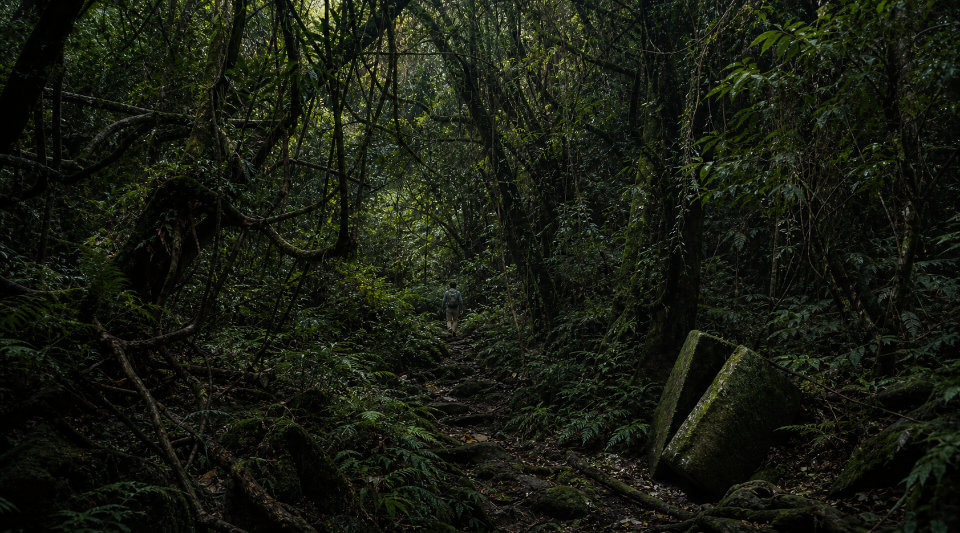
10. What is the relationship between Nakata’s quest for the “entrance stone” and Kafka’s journey into the forest?
When the stone becomes heavier than usual, it means that it is ready to function as a portal to another parallel world: the spirit world. The spirit world is the world Kafka visits at the end of the novel.
Nakata mentions that the Entrance Stone is the entrance to a realm he had already visited when he was in a coma. When Nakata opened the entrance stone, Kafka was able to get into the spirit world, which is actually the forest he was exploring near the mountain cabin. Now, this might confuse you, because why would the spirit world, such an important realm, be situated exactly near the cabin where Kafka happens to be hiding? Is it like a stargate or something? No. This is where it is useful to ditch all preconceptions of spacetime. The forest is a psychological world – a living entity of sorts – something that is experienced within one’s mind.
Remember the words of Oshima:
“Which means that the principle for the labyrinth is inside you. And that correlates to the labyrinth outside. […] Things outside you are projections of what’s inside you, and what’s inside you is a projection of what’s outside. So when you step into the labyrinth outside you, at the same time you’re stepping into the labyrinth inside.”
Similarly, Kafka says: “This forest is essentially a part of me, isn’t it? This thought takes hold at a certain point. The journey I’m taking is inside me.” “I head for the core of the labyrinth, giving myself up to the void”. In other words, Kafka is exploring the labyrinth within himself. Heading towards the “core of the labyrinth” of the forest is tantamount to going deeper into his own psyche.
This may suggest that not everyone is able to cross to the spirit world or to our reality once the entrance stone is opened. This seems to be tied to each individual and their connections. Nakata appears to be connected to both Kafka and Miss Saeki, so once Nakata opens the entrance stone, these two characters are able to cross realms (the evil spirit appears to be able to cross realms as well, so it could be that it too is connected to Nakata). And, remember, this is happening at a psychological level, not really at a physical one.

11. In what ways can Kafka on the Shore be read as a love story?
In Chapter 3, Oshima tells Kafka about an ancient theory that categorised people into male/male, male/female, and female/female. Then God split people in two halves, such that the world was now divided into only male and female. Humans are destined to spend their entire lives searching for their missing half. So, everyone is isolated and incomplete because they have not yet found a soul that completes them.
Miss Saeki and her childhood love are a perfect example of this. They began a romantic relationship when they were teenagers, and were initially “like one body and one spirit”. However, when her love moved away to Tokyo, it felt like they had been split in half with a knife. Miss Saeki composed the beautiful song “Kafka on the Shore” as a homage to her boyfriend, but just as the song was becoming a hit, he tragically died.
In my reading of Kafka on the Shore, I could see how this could be read as a love story. Kafka’s spirit Crow is really a manifestation of Miss Saeki’s lost love. So the entire journey of Kafka and Nakata is essentially the closure of Miss Saeki’s and her lover’s love story.
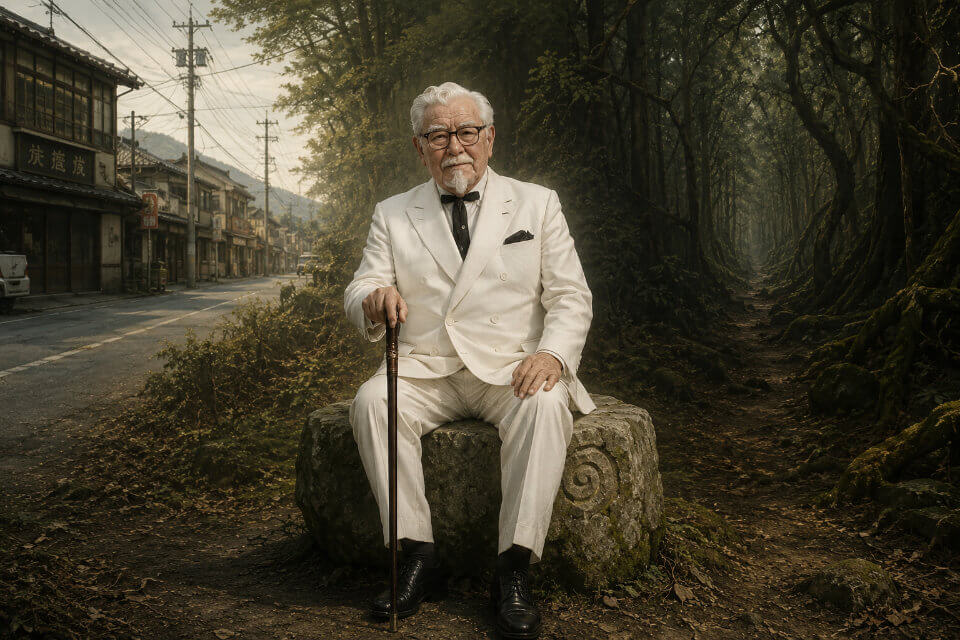
12. The supernatural shape-shifter, who takes the form of Colonel Sanders, tells Hoshino that he is neither God nor Buddha but a kind of “overseer, supervising something to make sure it fulfills its original role. Checking the correlation between different worlds, making sure things are in the right order” [p. 284]. What are these different worlds? Is Colonel Sanders talking about parallel universes?
The different worlds can be thought of as parallel universes, not in the physical sense, but rather as different planes of existence: reality vs dreamworld, conscious vs unconscious, life vs death.
The forest that Kafka enters at the end of the novel represents this other world. It is the same world Nakata visited after losing consciousness as a kid. And it is the same world Miss Saeki visited when she was 15 years old.
The entrance stone is crucial for travelling between these two worlds. Remember that when Nakata opened the entrance stone later in the novel, Miss Saeki was able to enter the spirit realm that Kafka encountered in the forest. Crucially, Miss Saeki had died, so the fact that Kafka met her in this other world suggests that Kafka either committed suicide, or was on the verge of death when he entered the spirit world.
Oshima says that himself:
“There’s another world that parallels our own, and to a certain degree you’re able to step into that other world and come back safely. As long as you’re careful. But go past a certain point and you’ll lose the path out. It’s a labyrinth. Do you know where the idea of a labyrinth first came from?”
Now, the spirit world inhabited by spirits is a realm that contains a shared consciousness (the prototypical memory that is described in question 8). So when Kafka meets Miss Saeki in the spirit world, he is experiencing this shared consciousness within his own mind (I find it useful to imagine this as if you transferred your thoughts, emotions, and desires into a virtual avatar, and let it enter a multi-user virtual world, where other avatars from other users can interact with yours).
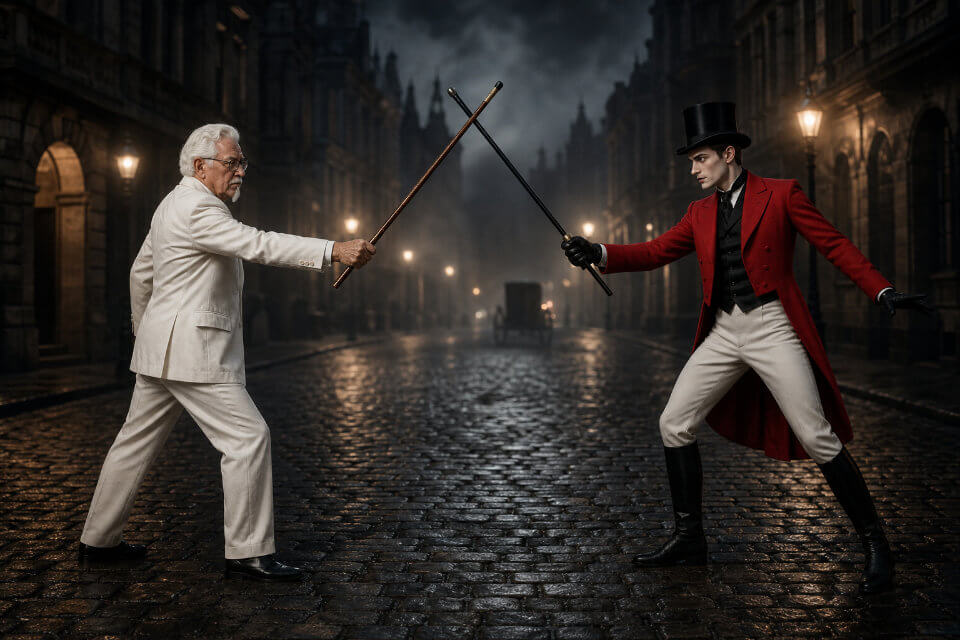
13. Kafka on the Shore is, for the most part, a realistic novel, yet it contains many magical elements—Nakata’s ability to talk with cats and make fish fall from the sky, the shape-shifting Colonel Sanders, the middle-aged Miss Saeki visiting Kafka as her fifteen-year-old self. What is Murakami saying about the nature of reality and our beliefs about it through these seemingly impossible episodes?
Nakata’s abilities
Before Johnnie Walker’s death, Nakata could communicate with cats, and there was no indication that he could control metaphysical phenomena or even be aware that an entrance stone existed. However, after Nakata kills Johnnie Walker he immediately loses the ability to talk with cats, but gains the ability to make accurate predictions, like knowing that fish will fall from the sky. Nakata also understands that he needs to find an entrance stone to restore equilibrium, which is what Colonel Sanders oversees. This indicates that Nakata’s powers somehow changed: they are initially beneficial to Johnnie Walker (i.e., being able to talk with cats so that Nakata can find him), but later become beneficial to Colonel Sanders (e.g., being able to follow his intuition to travel to Takamatsu, and find the entrance stone).
Colonel Sanders
Here is an important say by Colonel Sanders: “I’m kind of an overseer, supervising something to make sure it fulfils its original role. Checking the correlation between different worlds, making sure things are in the right order. So results follow causes and meanings don’t get all mixed up. So the past comes before the present, the future after it.”
Later, Nakata tells Miss Saeki: “My role is to restore what’s here now to the way it should be […] And as I’m sure you[Miss Saeki]’re aware, you can’t stay here any more”.
So, the shape-shifting Colonel Sanders is actually a metaphysical object which purpose is to restore balance to the reality-spirit divide, which has been disrupted ever since Miss Saeki opened the entrance stone. My interpretation is that perhaps Colonel Sanders is referring to the release of Johnnie Walker, which took over Kafka’s father when Miss Saeki opened the entrance stone. After Nakata kills the evil spirit Johnnie Walker, the latter now roams the limbo, waiting for the opening of the entrance stone in order to gain access to the physical world. Colonel Sanders sees that as a threat to the balance of both worlds, so tasks Nakata to find the entrance stone, helping him fulfilling this purpose. In a way, Johnnie Walker and Colonel Sanders are like yin and yang, two sides of the same coin: the former wants to disrupt the balance, while the latter wants to restore it.
15-year-old Miss Saeki
Check out this passage in Kafka on the Shore:
“The drowning girl’s fingers
Search for the entrance stone, and more.
Lifting the hem of her azure dress,
She gazes– At Kafka on the shore.
The girl who comes to this room most likely located that entrance stone. She’s in another world, just as she was when she was 15, and at night she comes to visit this room. In her light blue dress, she comes to gaze at Kafka on the shore.”
So the 15-year old Miss Saeki located and opened the entrance stone. How she did it, it is never revealed. But as a consequence of it, part of her spirit remained in the timeless spirit world, visiting Kafka in his room.
I believe that the same way Nakata was able to see Johnnie Walker (another spirit), so could Kafka see the spirit of 15-year-old Miss Saeki. My interpretation is that this is happening at the crossing between worlds (see question 7) where spirits can momentarily interact with the real world even though they cannot physically change the real world. This is why when Nakata stabs Johnnie Walker, he does not really kill him, but rather his vessel, Kafka’s father. Maybe Nakata, like Kafka, is able to “see through” people, to see their souls/spirits.
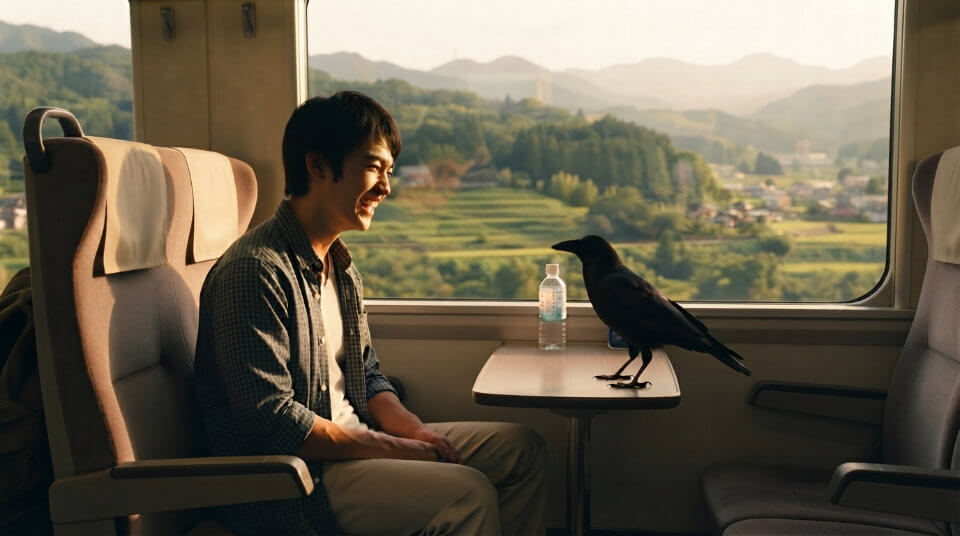
14. At the end of the novel, Oshima tells Kafka, “You’ve grown up” [p. 463]. In what ways has Kafka been changed by his experience? What are the most important things he has learned? Why does he feel he has entered “a brand-new world” [p. 467]?
Kafka learns to become aware of himself as someone who is not merely driven by his desires, fears, and the judgements of others. At the beginning of the novel, Kafka is portrayed as a lonely fellow, with low self-esteem, and isolated from other people. He also finds it difficult to establish meaningful relationships, likely as a consequence of being abandoned by his mother and despised by his father. Crucially, he attempts to understand and define himself in isolation, believing that by being “the world’s toughest fifteen-year-old”, he will not need other people. However, Kafka’s identity is clearly still very much shaped by his fear of abandonment, his loneliness, and his father’s prophecy.
Through his encounters with other characters (e.g., Sakura, Miss Saeki, Oshima) Kafka learns to see himself from outside his own limited perspective. By confronting his desires and fears, he becomes gradually aware of himself as a person with his own identity and freedom, rather than allowing himself to be controlled by other people’s opinions of him.
At the same time, Kafka gradually learns to recognize other people’s histories, desires, and perspectives. Miss Saeki is particularly relevant to this learning. Because of his strong feelings of abandonment by his mother, Kafka begins to project his own needs and fantasies onto Miss Saeki, even without confirmation that she is his actual biological mother. But once Kafka starts to acknowledge her existence as a person with her own history, trauma, desires, and relationship to the past, he learns to reflect upon his desires (rather than merely satisfy them) and to distinguish his own needs from the independent reality of another person.
That is why Kafka’s stay in the forest is so important. The forest can be interpreted as Kafka’s own unconscious, where he confronts those aspects of himself that he has previously tried to escape. However, for this confrontation to be successful Kafka needs to accept his own vulnerability and his connection to other people. His experiences in the forest, particularly the interactions with Miss Saeki’s spirits, are all part of this process through which he develops a new understanding of himself.
This is pretty much the discussion Hoshino had with the philosophy student/sex worker on Hegelian philosophy. For Hegel, one cannot become a fully independent self simply by withdrawing from other people. Self-consciousness develops through encounters with other self-conscious individuals, as these encounters challenge our limited understanding of ourselves and force us to recognise others as independent beings rather than merely objects that satisfy our desires.
He entered “a brand-new world” in the sense that he became a more developed individual: better able to distinguish himself from the fears and desires that previously defined him, and to accept his past without allowing it to completely determine his identity. His decision to go to the police to face the consequences of his actions and continue junior high once he arrives in Tokyo suggests that he has acquired a greater sense of agency and self-determination.

Leave a comment
Add Your Recommendations
Popular Tags