
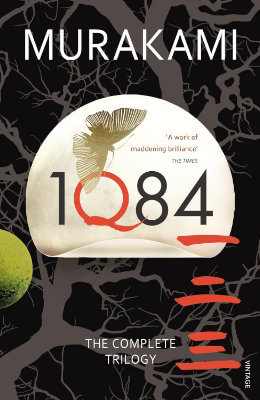





Having had a pleasant reading experience with Kafka on the Shore, I decided to go on a reading spree through Murakami’s books (this will eventually turn into a top list).
After having read George Orwell’s novel 1984, I knew 1Q84 had to be a pun. I wasn’t totally wrong.
But be warned: reading 1Q84 will test your patience and, if you are like me, test your resistance to falling asleep. Read on to find out why.
Review
1Q84 tells three interlocked stories from three different perspectives. Aomame is a vigilante of sorts; trained in martial arts, she assassinates men who brutally attack women. Tengo is less interesting by comparison – a lonely math teacher and aspiring author, living his life day by day without much excitement in it. The third major character, Ushikawa, is a perspicacious private detective who seems detached from society and shows little interest in other people. Ushikawa works on behalf of a sinister cult – the Sakigake – which practices comes to Aomame’s attention. Soon, the three stories become interconnected as the three characters get embroiled in the affairs of Sakigake.

The Good
Split among three volumes, 1Q84 is a massive book of over 1000 pages, depending on the edition. I purchased the audiobook as well, waited until it got dark and the moon was out in the sky, put on my headphones, and went into the woods alone, walking more or less at random while listening to 1Q84 (I by no means recommend that you go into the woods at night on your own, especially if you live in a dodgy area, but I tend to do crazy s**t sometimes, so pay me no heed).
Yeah… Listening to Murakami’s fantastical imagination and world-building, while looking at the full moon above me was a worthwhile experience. If you have read the novel, you know what I’m talking about: the atmospheric descriptions of the two moons were probably among the most fascinating ideas in the entire book.
In fact, the magical realism is really where 1Q84 shines. From the mysteriously terrifying cult of Sakigake and its abhorrent practices, to the train ride leading to Cat Town, there is plenty of weird stuff going on to keep you intrigued.
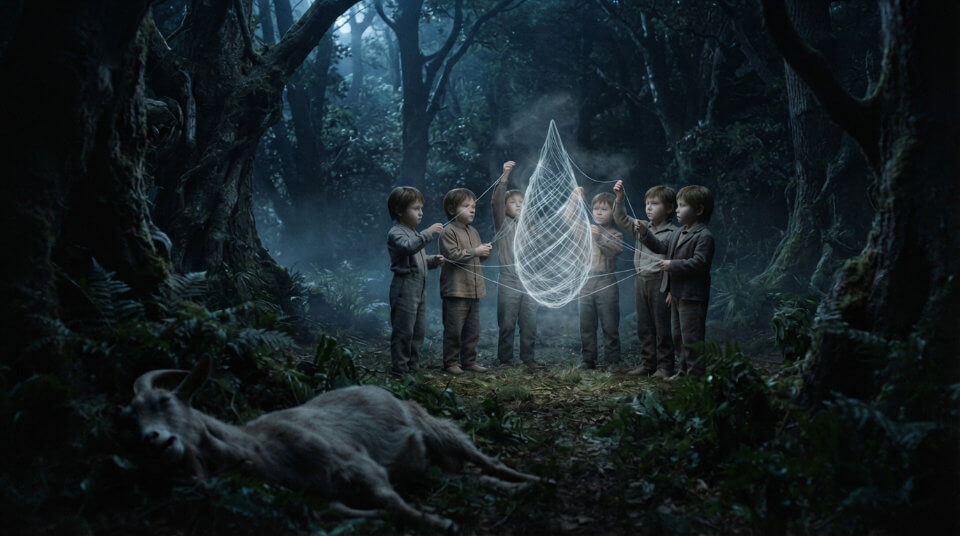
The Little People were as fascinating as they were scary. I kind of imagined them as a spooky version of Snow White’s dwarfs, given their supernatural influence on reality. Their exhalations “Ho, ho, ho”, which forever ruined Santa Claus’ greeting for me, were creepy beyond words. At night, the Little People construct an air chrysalis, a womb-shaped cocoon made up of white threads plucked out of the air. This is what I mean by Murakami’s outstanding imagination and magical realism. Who thinks of this stuff?!?
And I must say that I did enjoy the ending. It was predictable in a sense, but it was also unpredictable. I kind of expected Tengo and Aomame to reunite – that was obvious; but what I did not expect was for them to end up in a slightly different universe .
The characters are certainly fleshed out (there are plenty of pages to do so anyway), but they are not exactly relatable. Aomame was a departure from the more passive female characters that tend to permeate Japanese literature, so it was interesting to see her as an empowered character – who doesn’t like to see a female martial artist kicking men’s arses? Still her behaviour was a bit childish at times, which was perhaps suggested by her sexual promiscuity, and her rambling about her small boobs. Tengo is more of a loner who is not unsympathetic per se, but rather unemotional and boring. Ushikawa was probably my favourite character, mostly due to his I-don’t-give-a-rat’s-arse-about-what-people-think-of-me kind of attitude and the fact that he was tenacious and diligent in his work.
But I’m afraid the bad points far outweigh the good ones.

The Not-So-Good
First, I’m pretty sure that anyone who has read this novel has noticed how much filler the book contains. The story is undeniably interesting with rich and unique magical realism, but it is so sparsely paced that it seems to be going nowhere. And I simply don’t get it. Why did Murakami opt for such a long-winded novel, full of tedious descriptions and countless repetitions? He could have told this story in half as many pages, and it would made for a very good narrative.
Just take a look at some of the descriptions:
“He went back to his apartment with a bag of groceries in his arms. Changing into shorts, he took a cold can of beer from the refrigerator and drank it, standing, while he heated a large pot of water. Before the water boiled, he stripped all the leathery edamame pods from the branch, spread them on a cutting board, and rubbed them all over with salt. When the water boiled, he threw them into the pot.”
“Taking off his raincoat, he set a radio cassette player on the kitchen table. He removed the cassette from the padded envelope and inserted it into the player, next to which he placed memo paper and a ballpoint pen in case he wanted to take notes. After looking around to make certain there was no one else present, he pressed the “play” button.”
To me, these descriptions sound like Murakami thinks readers need to be reminded that in order to play music we need to remove the cassette from the envelope, and then press the “play” button. It almost feels as though Murakami forgot to mention that we need to raise our arm and move it towards the cassette, then we need to flex our fingers and grab the cassette with our thumb and index fingers. Then pull it out, and with the index finger of our other hand, press the button to open the player’s lid, at which point our right hand inserts the cassette into the player. Honestly, doesn’t my description sound like something Murakami would write? I only showed two examples above, but 1Q84 is filled with such redundant passages that completely thwart the flow of the storyline.
The same goes for the endless repetitions. 1Q84 was published in three volumes: books 1 and 2 were published on the same date whereas book 3 was published a year later. Perhaps Murakami wished to remind readers about some of the events from the preceding books, but it just gets to be far too much. For example, there is no shortage of reminders about Tengo’s childhood in Books 1 and 2. Then, Murakami decides to devote an entire chapter of Book 3 to Ushikawa learning the exact same information about Tengo’s childhood and school years. And I mean the exact same information: we have already learnt every relevant detail about Tengo’s school years, but then we get pages and pages devoted to the same information all over again.
Even more annoying is Tengo’s habit of repeating what others say, in conversations that have already dragged on for pages and pages:
“I have something bigger in mind,” Komatsu said.
“Something bigger?”
[…]
“The Akutagawa Prize!” Komatsu declared after a moment’s pause.
“The Akutagawa Prize?” Tengo repeated the words slowly, as if he were writing them in huge characters with a stick on wet sand.
[…]
“Only, in this case, rather than the author, someone else will do the revising.”
“Someone else?” Tengo asked, but he already knew what Komatsu’s answer would be.
[…]
Fuka-Eri paused before she said, “Just like you and me.”
“Just like you and me,” Tengo repeated.
[…]
“One thing should be perfectly clear. My wife is irretrievably lost. She can no longer visit your home in any form. That is what I am saying.”
“Irretrievably lost,” Tengo repeated.
[…]
“I don’t have a son,” his father declared.
“You don’t have a son,” Tengo repeated mechanically.
I won’t go on, but this should give you a pretty good idea of what I mean.
Also, the writing in this novel shows a certain fixation on breasts. Even setting aside Tengo’s recurrent “memory” of a man, who was not his father, suckling his mother’s breasts, or Aomame’s incessant whining about her small breasts (she keeps saying she doesn’t mind, but clearly, she does), female characters are almost always introduced through descriptions of the shape and volume of their breasts. Tengo’s image of little Aomame was of a “skinny little girl without breasts”, Tengo started dating girls with their “brand-new breasts”, Ayumi is described as follows: “By no means fat, the woman was round everywhere, including her face, which radiated a truly friendly warmth, and she had big breasts”.
In turn, Fuka-Eri’s “breasts could not help but attract attention. They were beautifully shaped as well. Tengo had to caution himself not to look down there, but he couldn’t help it. His eyes moved to her chest as if toward the center of a great whirlpool”. Even the elderly dowager isn’t safe from Murakami’s seeming obsession: “Her body shape had not disintegrated, and even her breasts had a degree of firmness”. Breasts, breasts, breasts…
What about Aomame’s explanation of how pregnancy tests work. She goes on for page after page, and it almost looks as if Murakami had copy-pasted the instructions from a Clearblue instruction leaflet.
Second, the prose was very basic, unrefined and, frankly, monotonous. It didn’t help that I had just read China Miéville’s Perdido Street Station before 1Q84, as they couldn’t be more different. Having been impressed by China Miéville’s impeccable prose and command of vocabulary, reading 1Q84 was like switching from a Bugatti Chiron to an Austin Metro (I’m very fond of the Austin Metro by the way, as it was the very first car I had. I’ve never driven a Bugatti Chiron ☹).
Maybe it’s unfair to compare writing styles, because I actually think Murakami is a good writer. But the prose he chose for 1Q84 was so full of platitudes and the language was so simplistic and flat, that it was almost unbearable at times.
In fact, many of his descriptions were so corny that I could not avoid rolling my eyes. Here are some examples:
“Those eyes seemed to peer through the lens and focus directly on something the viewer kept hidden deep in his heart”.
“But in that time, Aomame seemed to have taken part of him with her – part of his heart or body. And in its place, she had left part of her heart or body inside him.”
Finally, I’m starting to get the feeling that Murakami is trying too hard to inject his own interests and obsessions into the narrative, to the point where it sometimes feels forced.
A case in point is classical music. His fondness for it is sweet, but I worry that classical music is being used more as an instrument for showing off his musical knowledge rather than as something that actually serves the plot. It is not rare to find characters repeatedly expressing their interest in some kind of random classical music composition (e.g., in Kafka on the Shore, it was the Archiduke Trio; in 1Q84, it is Janáček’s Sinfonietta). I can’t help wondering why (and how) does everyone in his books appears to listen to classical music. In Murakami’s books, and 1Q84 in particular, there are discussions of classical music as if classical pieces were the latest Taylor Swift singles. I don’t know, it feels a bit forced and unrealistic that the characters are either very knowledgeable about the music, or are immediately taken with it.
Star rating
This book had everything it needed to be a success, but, in my opinion, it failed miserably. No doubt Murakami is an excellent author and his imagination and magical realism are unique and commendable. Sadly, I do not think 1Q84 is a very good book.
The story is undeniably interesting, and it has such enormous potential: a female vigilante, weeding out scummy men from society, the bizarre and scary Little People, parallel worlds, and a bunch of loners destined to meet.
But you need to have the patience of a koala to get through this book. With over 1000 pages, there is so much repetition, padding, and clichéd writing that I wonder if Murakami actually read it from front to back before sending it out to his publishers. Why he insisted on making this a trilogy, when the story could have easily fit into a volume of fewer than 400 pages is something I will never understand.
Sadly, I don’t think this novel is worth weeks (or months, like in my case) of your precious time, so here at Mindlybiz 1Q84 receives a star rating of 1.5 out of 5.
Bizarrometer
Murakami is well-known for his fabulous imagination and ambiguous endings. I have only read two of his books so far (Kafka on the Shore being the other one), but when it comes to weirdness, 1Q84 is definitely not the weirdest.
If you think of the different worlds as parallel worlds, with the staircase serving as an entrance to these realms, then the story becomes closer to science fiction.
Of course, there are weird moments. The Little People and everything connected to them (such as the air chrysalis appearing out of thin air) are truly bizarre – bizarre and disturbing if you consider the Sakigake practices involving underage women. However, these events happen very sporadically, so most of the story is actually very linear and easy to follow.
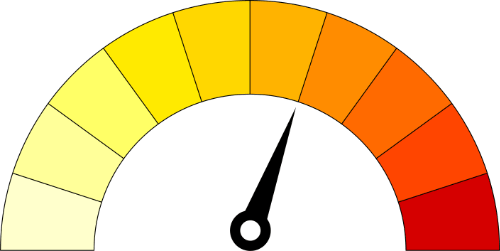
1Q84 gets a score of 3 on the Bizarrometer.

Leave a comment
Add Your Recommendations
Popular Tags