







Magnolia…
Great word!
Great flower!
Great film!
I was in mid-adolescence when the film came out, and it wasn’t hard to notice… Dozens of girls in my school couldn’t stop gushing about how gorgeous, fit and sexy Tom Cruise looked (though I sometimes wonder if they actually understood what he was saying…).
I started watching the movie thinking that this infatuation with Tom Cruise were clearly over the top, and worried it might bias my opinion of the film.
But Magnolia ended up being a very positive surprise.
Review
In Magnolia, compassionate nurse Phil Parma cares for TV mogul Earl Partridge, who is dying of cancer. Earl’s wife, Linda Partridge, is haunted by her own extra-marital affairs, while his son, Frank T. J. Mackey, riles up male audiences with sexist and misogynistic self-help shows. Jimmy Gator, the host of a popular TV quiz show, is also dying of cancer, and attempts to reconcile with his estranged, cocaine-addicted daughter Claudia Wilson. Jim Kurring, an insecure but kind-hearted policeman, takes an interest in Claudia. Meanwhile, Stanley Spector, a gifted child, is constantly controlled by his domineering father, while Donnie Smith, who was once a prodigy child himself, now feels like a failure and unloved.
Nine characters, nine stories.
Director Paul Thomas Anderson (PTA) once said in an interview that you aren’t watching individual pieces, but one single story. And indeed, that was the impression I had when I watched Magnolia. Throughout the movie, there is an undeniable thread linking seemingly unrelated characters, without any noticeable rupture. For example, Earl-Phil’s story seamlessly blends into Frank’s story; Jim’s story seamlessly blends into Claudia’s story; etc.
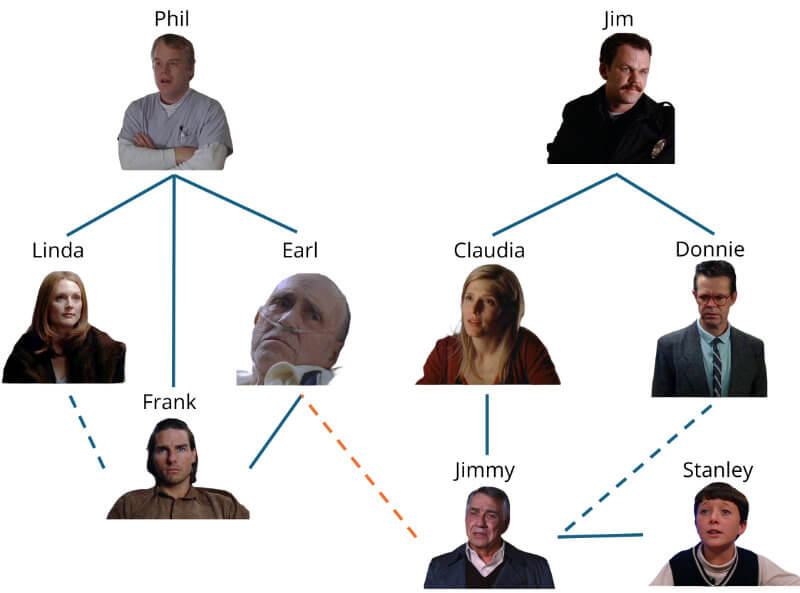
That is not to say that these connections couldn’t have been made more relevant and interesting (the movie Babel, in my opinion, does this exceptionally well, even though its characters are mostly from different countries). As shown in the figure above, there appear to be two clear clusters: one involving Frank, Linda, Earl and Phil (dashed lines represent known links although characters never directly meet in the movie). Another involving Jimmy, Claudia and Jim. Donnie and Stanley occupy more peripheral roles. The link between the two main clusters is relatively weak, connected only indirectly via Earl and Jimmy, the former being Jimmy’s TV boss (dashed orange line in the figure above).
Even though the individual stories are not exactly thrilling on their own, they are certainly attention-grabbing. Think about it: a policeman hoping for a date with a cocaine-addicted woman; a TV host with cancer on his final show; a pickup artist giving motivational talks; a man determined to steal in order to pay for braces he doesn’t even need. None of these storylines scream excitement, and they are admittedly underdeveloped. Yet, when the stories come together, coupled with incredible acting and beautiful soundtrack, the effect is almost magical. Even if the individual stories lack a certain depth, they complement each other within the broader theme of the movie. It’s almost like each story consists of a piece of a larger puzzle: a single piece is unremarkable on its own, but, collectively, they form a much richer picture.
While the inescapable convergence of storylines appears to be the main theme of the movie, there is also the idea of unresolved past persisting into the present – for example, parental abuse or neglect leading to self-loathing children, or tormented characters coming to terms with regret for their past actions. In many ways, most of the characters share similar traumatic experiences (e.g., Claudia, Stanley, Donnie and Frank all endured abusive or neglectful parents) that continue to influence their present life circumstances.
But don’t expect any neat catharsis by the end. While some characters find a measure of closure, we never really feel that any of their stories reach a happy ending (or even definite ending for that matter). What happens to Frank and Linda? Will they reconcile despite their past divergences? And Jimmy? Will he survive his suicide attempt? What about Stanley? Did confronting his father produce any real change? Even the conversation between Jim and Claudia is muffled by the music in the background, as if we are not meant to know how their stories end. It’s almost as though the director deliberately omitted any resolution, much like a musical composition that ends without a proper cadence.
And that’s OK, no need for a sequel. A sequel would have likely ruined the mystery of the future, as they so often do. Perhaps not everything will turn out alright for some of characters, but knowing that each of them rose up to the challenges in their lives, overcame loneliness, and grew as people, offers a kind of a closure in itself, doesn’t it? To me, that is already a satisfying way for a film to end.
Let’s talk about acting now! Wow! The entire cast – no exceptions – was unbeliable! Astonishingly, none of them won an Oscar for it (Tom Cruise came close, having been nominated for Best Supporting Actor). In a way, it’s understandable. With such an ensemble cast, many scenes are only two or three minutes long per character, making serious character development extremely difficult, even in a movie that runs over three hours.
I suppose that is my only real criticism – unfortunately, there is always a compromise to be made. Would I have preferred removing a character or two in favour of more fully fleshed-out stories for the remaining cast? Perhaps. I felt that Donnie’s and Stanley’s stories were as well connected as the others, so the film might have survived with their absence, even though their struggles surely fit with the overall theme.
And speaking of Cruise: Cruise’s character Frank T. J. Mackey is so utterly reprehensible that you immediately start wishing for his downfall the moment he opens his mouth. It becomes clear very early on that Frank has “daddy issues”. Not only did his father abandon him and his dying mother, but he also frequently cheated on her, psychologically abused her, and left her to die, forcing Frank to care of her on his own. It is thus strange that Frank channels his anger toward women, when his hatred is so clearly directed at his father. To my knowledge, there’s no evidence that men with “father issues” are more prone to misogyny.
However, as Frank’s story unfolds and we get to know him a little better, it becomes apparent that his attitude is largely a façade – a defense mechanism of sorts to cope with the trauma of caring for his dying mother alone after his father’s abandonment. It was a bold move from the director. Frank is undeniably despicable at first, but by the end, he becomes surprisingly relatable and even somewhat lovable.
The sound design and mixing are exceptional. In one particular middle section, beginning with Jim after hearing Dixon’s rap, the background music starts with a light but curious beat, maintaining a subtle tension throughout. What’s particularly innovative is the layering of additional music on top of this – for example, when Donnie enters the bar and music is playing, or when the Jim interrogates Claudia, who is listening to loud music (which fit the mood of those scenes). Despite these distinct musical moments, the underlying score remains present, almost as if tying the events together into a single cohesive composition. Interestingly, this continuity only resolves when Jimmy announces “End of round 1”, as if everything that just occurred was intended to be experienced as one uninterrupted take.
Another musically rich scene is the conversation between Claudia and Jim set against the opera Carmen. The interaction is so awkward and cringe-inducing that you simply can’t look away, with the music amplifying every uncomfortable beat.
And that is another aspect that Magnolia excelled in. Virtually all the character interactions are superbly crafted, and conversations between any two characters always brim with tension. Obvious examples include Frank’s interview with the female reporter, who presses him about his past, and Jim’s interrogation of the nervous, drug-addict Claudia.
Now, while the soundtrack is highly effective in most cases, I found the synchronised singing to Aimee Mann’s song “Wise up” a bit underwhelming. I realise this opinion may not sit well with many fans, who praised the choice of song for that particular moment. In my view, however, the lyrics and mood of the song simply don’t fully align with the broader momentum of the movie, in which most characters are confronting their loneliness. The song appears to be specifically about drug addiction, which fits Claudia’s storyline but is less relevant to the others. Director PTA apparently had a close working relationship with Aimee Mann (the writer of the song) and may have been listening to her music while writing Magnolia. Perhaps he felt compelled, on a whim, to include one of her songs. Personally, I wouldn’t read too much into it, and I found it to be a weaker element in the movie.
Finally, it was quite hard to tease out the relevance of the prologue, which ostensibly sets the stage for the main narrative of Magnolia. The prologue presents three cases which imply pure coincidence (Greenberry hill), coincidence with consequences (Darrion/Hansen) and causal tragedy (Barringer). These cases may or may not be relevant to the main storyline of Magnolia, and I’ll discuss them in greater detail in my upcoming deep-dive explanation of the movie. Stay tuned!
Star rating
Magnolia is a great movie. I’m not sure I’d go so far as to call it one of the best movies I have ever seen, but it comes close. It’s a pity the stories weren’t devised to be a bit more interconnected, perhaps with a few more interesting twists. Still, the casting was formidable; every actor delivers an outstanding performance, with Tom Cruise arguably pulling off his best performance to date.
The soundtrack was exceptionally powerful, with clever and engaging musical choices. In particular, I appreciated the way a single track builds tension while threading through multiple storylines.
This must have been an incredible difficult film to make, and the editing even more so. Magnolia was a movie that could have easily failed, given the ambitious project with an ensemble cast, multiple individual stories to connect, and limited runtime. Having watched behind-the-scenes footage, I can see that it was the unity and perseverance of the entire team that made it truly work.
Magnolia gets 4 stars here at Mindlybiz.
Bizarrometer
Someone once suggested to me I should watch Magnolia for its obvious weirdness. And, yes, most would agree that the rain of frogs is an undoubtedly strange moment, perhaps even a surreal one. Contrary to the idea that this scene is meant to be a direct reference to the Bible, and despite the film’s clear allusions to the Book of Exodus (which describes the plague of frogs among several others), PTA has stated that he only realised it was a biblical event during the shooting of Magnolia. Thus, it seems much more likely that the frog rain was intended as a literal, albeit extremely rare, natural phenomenon that can be explained through bizarre meteorological events.
The interconnectivity of the storylines is an unusual narrative device, but not weird in the strict sense of the word – all the individual stories are pretty much grounded in reality and there is no magical realism involved. However, what makes the film slightly stranger is the way it hints at a deeper, underlying meaning. Repeated references to coincidence, chance encounters, and causality (e.g., prologue), combine with the broader themes of loneliness, regret and fate. These hidden thematic threads only really emerge when the film is considered as a whole, by observing how the stories echo one another.
For that reason Magnolia receives a Bizarrometer score of 1.
Leave a comment
Add Your Recommendations
Popular Tags