

Search in:
Filter posts by category:

Magnolia

Director: Paul Thomas Anderson

Producer: JoAnne Sellar, Paul Thomas Anderson

Writer: Paul Thomas Anderson

Starring: Tom Cruise, Julianne Moore, Philip Seymour Hoffman, Jason Robards, Philip Baker Hall, William H. Macy, John C. Reilly, Melora Walters, Jeremy Blackman

Year: 1999

Duration: 3h 13m

Country: USA

Language: English

Our rating

Full StarFull StarFull StarFull StarEmpty Star
4 / 5
Really good
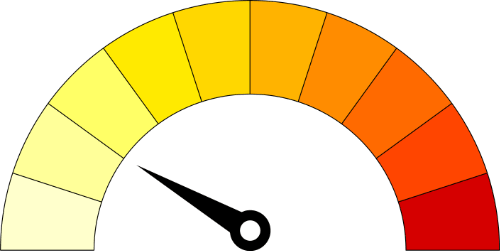
Bizarrometer Slider
1 / 5
Not very weird

Good Points

  • Exceptional ensemble acting throughout, particularly Tom Cruise
  • Ambitious, cohesive multi-character narrative
  • Powerful, innovative soundtrack and sound design
  • Tense, well-written character interactions

Bad Points

  • Individual stories feel underdeveloped
  • Weak connections between characters
  • Prologue relevance remains unclear

Your rating

.0
.0

Table of Contents

Table of Contents

Magnolia…

Great word!

Great flower!

Great film!

I was in mid-adolescence when the film came out, and it wasn’t hard to notice… Dozens of girls in my school couldn’t stop gushing about how gorgeous, fit and sexy Tom Cruise looked (though I sometimes wonder if they actually understood what he was saying…).

I started watching the movie thinking that this infatuation with Tom Cruise were clearly over the top, and worried it might bias my opinion of the film.

But Magnolia ended up being a very positive surprise.

Review

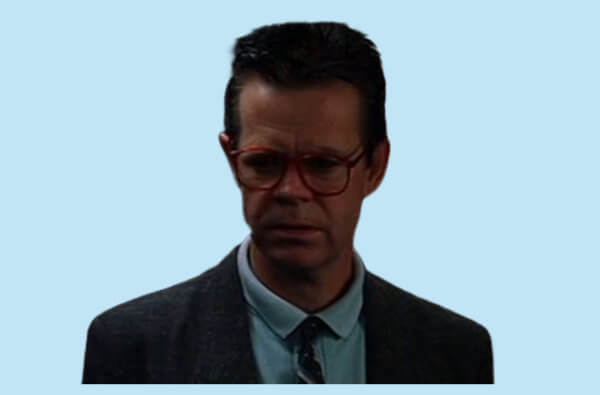
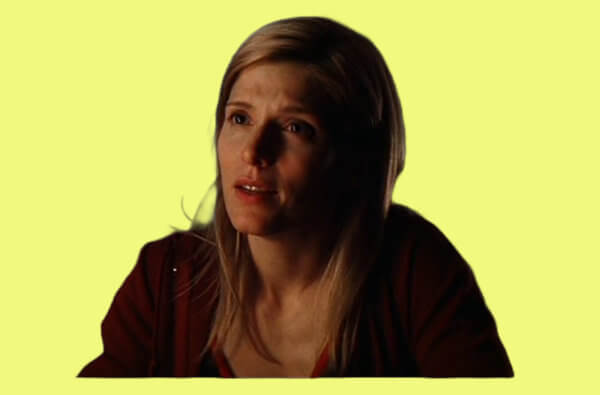
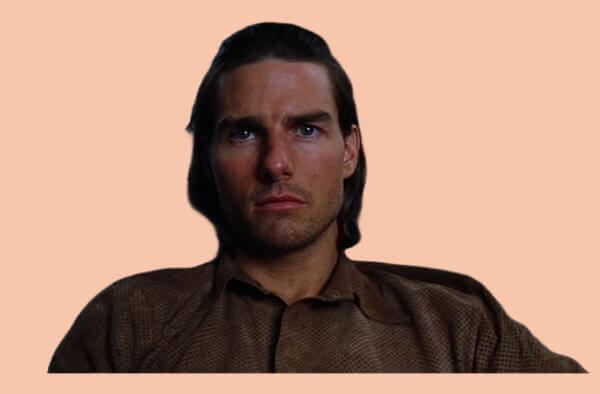
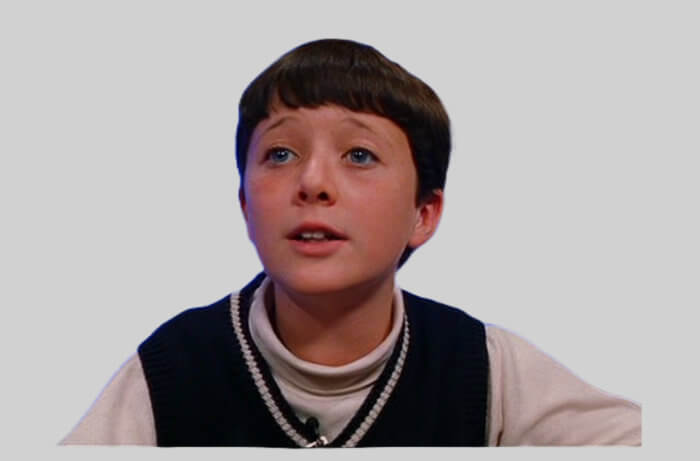
In Magnolia, compassionate nurse Phil Parma cares for TV mogul Earl Partridge, who is dying of cancer. Earl’s wife, Linda Partridge, is haunted by her own extra-marital affairs, while his son, Frank T. J. Mackey, riles up male audiences with sexist and misogynistic self-help shows. Jimmy Gator, the host of a popular TV quiz show, is also dying of cancer, and attempts to reconcile with his estranged, cocaine-addicted daughter Claudia Wilson. Jim Kurring, an insecure but kind-hearted policeman, takes an interest in Claudia. Meanwhile, Stanley Spector, a gifted child, is constantly controlled by his domineering father, while Donnie Smith, who was once a prodigy child himself, now feels like a failure and unloved.


Nine characters, nine stories.

Director Paul Thomas Anderson (PTA) once said in an interview that you aren’t watching individual pieces, but one single story. And indeed, that was the impression I had when I watched Magnolia. Throughout the movie, there is an undeniable thread linking seemingly unrelated characters, without any noticeable rupture. For example, Earl-Phil’s story seamlessly blends into Frank’s story; Jim’s story seamlessly blends into Claudia’s story; etc.
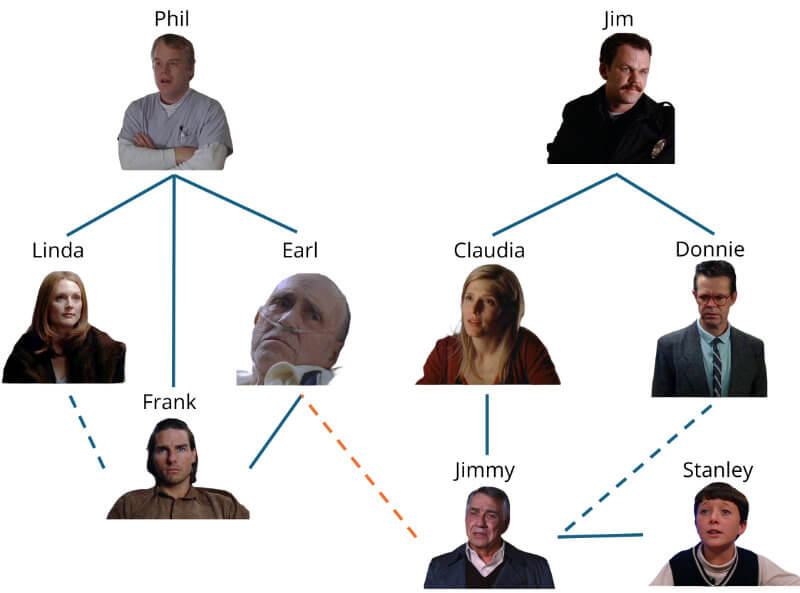
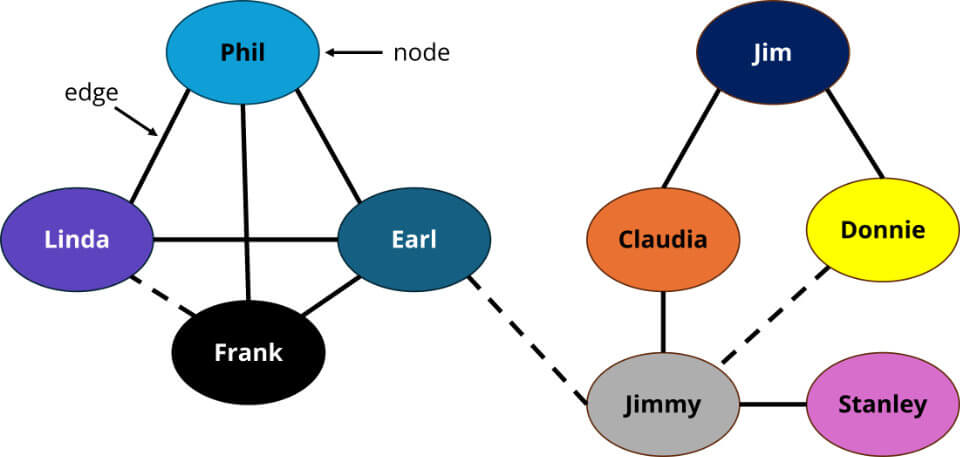
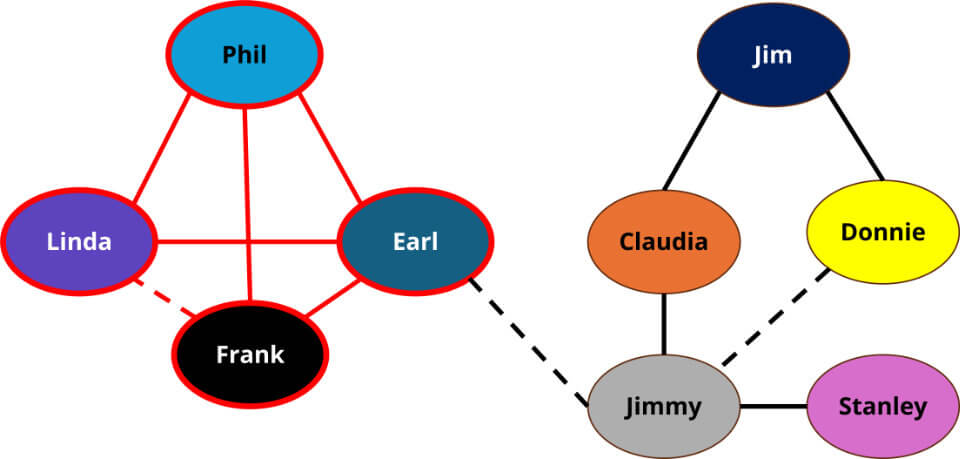
That is not to say that these connections couldn’t have been made more relevant and interesting (the movie Babel, in my opinion, does this exceptionally well, even though its characters are mostly from different countries). As shown in the figure above, there appear to be two clear clusters: one involving Frank, Linda, Earl and Phil (dashed lines represent known links although characters never directly meet in the movie). Another involving Jimmy, Claudia and Jim. Donnie and Stanley occupy more peripheral roles. The link between the two main clusters is relatively weak, connected only indirectly via Earl and Jimmy, the former being Jimmy’s TV boss (dashed orange line in the figure above).

Even though the individual stories are not exactly thrilling on their own, they are certainly attention-grabbing. Think about it: a policeman hoping for a date with a cocaine-addicted woman; a TV host with cancer on his final show; a pickup artist giving motivational talks; a man determined to steal in order to pay for braces he doesn’t even need. None of these storylines scream excitement, and they are admittedly underdeveloped. Yet, when the stories come together, coupled with incredible acting and beautiful soundtrack, the effect is almost magical. Even if the individual stories lack a certain depth, they complement each other within the broader theme of the movie. It’s almost like each story consists of a piece of a larger puzzle: a single piece is unremarkable on its own, but, collectively, they form a much richer picture.

While the inescapable convergence of storylines appears to be the main theme of the movie, there is also the idea of unresolved past persisting into the present – for example, parental abuse or neglect leading to self-loathing children, or tormented characters coming to terms with regret for their past actions. In many ways, most of the characters share similar traumatic experiences (e.g., Claudia, Stanley, Donnie and Frank all endured abusive or neglectful parents) that continue to influence their present life circumstances.

But don’t expect any neat catharsis by the end. While some characters find a measure of closure, we never really feel that any of their stories reach a happy ending (or even definite ending for that matter). What happens to Frank and Linda? Will they reconcile despite their past divergences? And Jimmy? Will he survive his suicide attempt? What about Stanley? Did confronting his father produce any real change? Even the conversation between Jim and Claudia is muffled by the music in the background, as if we are not meant to know how their stories end. It’s almost as though the director deliberately omitted any resolution, much like a musical composition that ends without a proper cadence.

And that’s OK, no need for a sequel. A sequel would have likely ruined the mystery of the future, as they so often do. Perhaps not everything will turn out alright for some of characters, but knowing that each of them rose up to the challenges in their lives, overcame loneliness, and grew as people, offers a kind of a closure in itself, doesn’t it? To me, that is already a satisfying way for a film to end.

Let’s talk about acting now! Wow! The entire cast – no exceptions – was unbelievable! Astonishingly, none of them won an Oscar for it (Tom Cruise came close, having been nominated for Best Supporting Actor). In a way, it’s understandable. With such an ensemble cast, many scenes are only two or three minutes long per character, making serious character development extremely difficult, even in a movie that runs over three hours.

I suppose that is my only real criticism – unfortunately, there is always a compromise to be made. Would I have preferred removing a character or two in favour of more fully fleshed-out stories for the remaining cast? Perhaps. I felt that Donnie’s and Stanley’s stories weren’t as well connected as the others, so the film might have survived with their absence, even though their struggles surely fit with the overall theme.

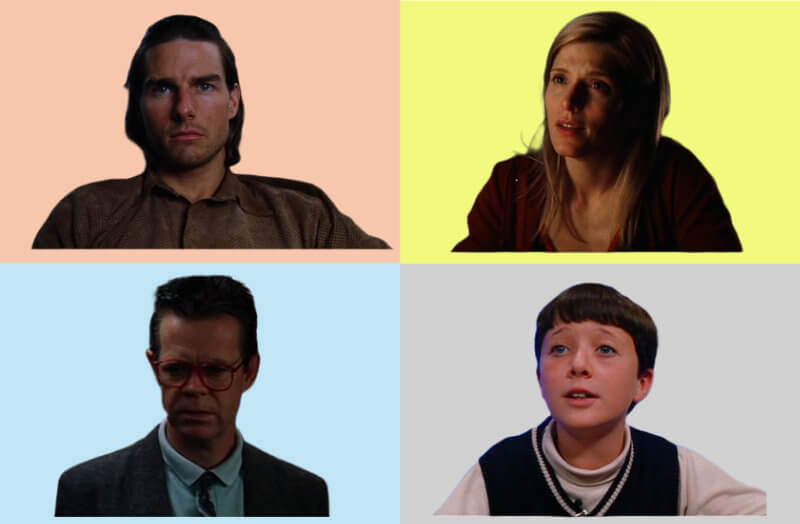
And speaking of Cruise: Cruise’s character Frank T. J. Mackey is so utterly reprehensible that you immediately start wishing for his downfall the moment he opens his mouth. It becomes clear very early on that Frank has “daddy issues”. Not only did his father abandon him and his dying mother, but he also frequently cheated on her, psychologically abused her, and left her to die, forcing Frank to care of her on his own. It is thus strange that Frank channels his anger toward women, when his hatred is so clearly directed at his father. To my knowledge, there’s no evidence that men with “father issues” are more prone to misogyny.

However, as Frank’s story unfolds and we get to know him a little better, it becomes apparent that his attitude is largely a façade – a defense mechanism of sorts to cope with the trauma of caring for his dying mother alone after his father’s abandonment. It was a bold move from the director. Frank is undeniably despicable at first, but by the end, he becomes surprisingly relatable and even somewhat lovable.

The sound design and mixing are exceptional. In one particular middle section, beginning with Jim after hearing Dixon’s rap, the background music starts with a light but curious beat, maintaining a subtle tension throughout. What’s particularly innovative is the layering of additional music on top of this – for example, when Donnie enters the bar and music is playing, or when the Jim interrogates Claudia, who is listening to loud music (which fit the mood of those scenes). Despite these distinct musical moments, the underlying score remains present, almost as if tying the events together into a single cohesive composition. Interestingly, this continuity only resolves when Jimmy announces “End of round 1”, as if everything that just occurred was intended to be experienced as one uninterrupted take.

Another musically rich scene is the conversation between Claudia and Jim set against the opera Carmen. The interaction is so awkward and cringe-inducing that you simply can’t look away, with the music amplifying every uncomfortable beat.

And that is another aspect that Magnolia excelled in. Virtually all the character interactions are superbly crafted, and conversations between any two characters always brim with tension. Obvious examples include Frank’s interview with the female reporter, who presses him about his past, and Jim’s interrogation of the nervous, drug-addict Claudia.

Now, while the soundtrack is highly effective in most cases, I found the synchronised singing to Aimee Mann’s song “Wise up” a bit underwhelming. I realise this opinion may not sit well with many fans, who praised the choice of song for that particular moment. In my view, however, the lyrics and mood of the song simply don’t fully align with the broader momentum of the movie, in which most characters are confronting their loneliness. The song appears to be specifically about drug addiction, which fits Claudia’s storyline but is less relevant to the others. Director PTA apparently had a close working relationship with Aimee Mann (the writer of the song) and may have been listening to her music while writing Magnolia. Perhaps he felt compelled, on a whim, to include one of her songs. Personally, I wouldn’t read too much into it, and I found it to be a weaker element in the movie.

Finally, it was quite hard to tease out the relevance of the prologue, which ostensibly sets the stage for the main narrative of Magnolia. The prologue presents three cases which imply pure coincidence (Greenberry hill), coincidence with consequences (Darrion/Hansen) and causal tragedy (Barringer). These cases may or may not be relevant to the main storyline of Magnolia, and I’ll discuss them in greater detail in my upcoming deep-dive explanation of the movie. Stay tuned!

Star rating

Magnolia is a great movie. I’m not sure I’d go so far as to call it one of the best movies I have ever seen, but it comes close. It’s a pity the stories weren’t devised to be a bit more interconnected, perhaps with a few more interesting twists. Still, the casting was formidable; every actor delivers an outstanding performance, with Tom Cruise arguably pulling off his best performance to date.

The soundtrack was exceptionally powerful, with clever and engaging musical choices. In particular, I appreciated the way a single track builds tension while threading through multiple storylines.

This must have been an incredible difficult film to make, and the editing even more so. Magnolia was a movie that could have easily failed, given the ambitious project with an ensemble cast, multiple individual stories to connect, and limited runtime. Having watched behind-the-scenes footage, I can see that it was the unity and perseverance of the entire team that made it truly work.

Magnolia gets 4 stars here at Mindlybiz.

Bizarrometer

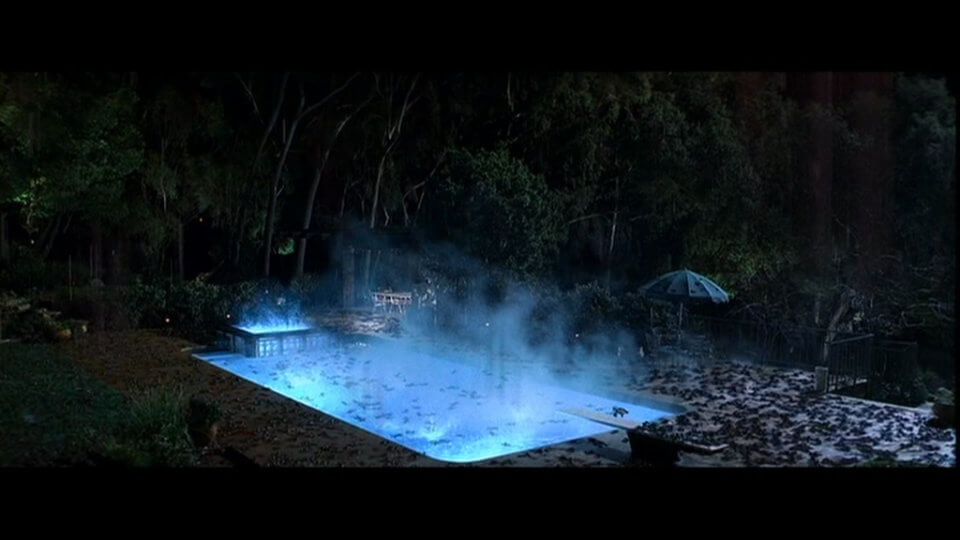
Someone once suggested to me I should watch Magnolia for its obvious  weirdness. And, yes, most would agree that the rain of frogs is an undoubtedly strange moment, perhaps even a surreal one. Contrary to the idea that this scene is meant to be a direct reference to the Bible, and despite the film’s clear allusions to the Book of Exodus (which describes the plague of frogs among several others), PTA has stated that he only realised it was a biblical event during the shooting of Magnolia. Thus, it seems much more likely that the frog rain was intended as a literal, albeit extremely rare, natural phenomenon that can be explained through bizarre meteorological events.

The interconnectivity of the storylines is an unusual narrative device, but not weird in the strict sense of the word – all the individual stories are pretty much grounded in reality and there is no magical realism involved. However, what makes the film slightly stranger is the way it hints at a deeper, underlying meaning. Repeated references to coincidence, chance encounters, and causality (e.g., prologue), combine with the broader themes of loneliness, regret and fate. These hidden thematic threads only really emerge when the film is considered as a whole, by observing how the stories echo one another.

For that reason Magnolia receives a Bizarrometer score of 1.
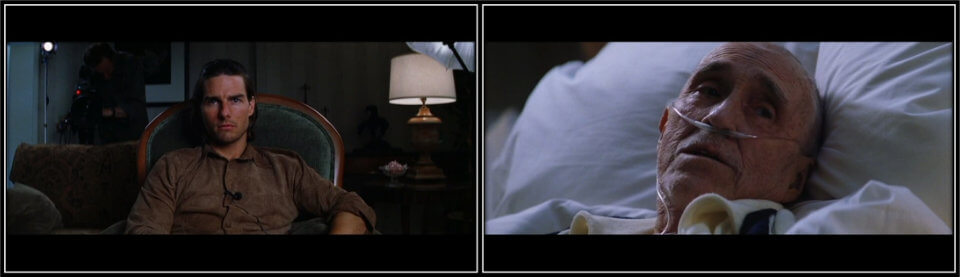
Magnolia Explained!

Ghosts of the past

“We may be through with the past, but the past is not through with us”.

The above sentence is an apparent quote of “the book” that both Donnie and Jimmy mention in Magnolia. What exactly “the book” is, no one knows. However, if there is one theme that is shared among the characters in Magnolia, it is how the past seems to get a foothold on the lives of each character.

There are numerous references to the past, with the characters’ histories surfacing repeatedly throughout film. Frank’s discomfort when the reporter presses him on his past is a clear indication of this. He tells her: “Facing the past is an important way of not making progress”, which is exactly the opposite message I believe the film is trying to convey.

You see, I often hear people claim that “the past is the past”, “that’s water under the bridge” and similar platitudes. But what Magnolia is implying is that past actions still have consequences in present life, especially if issues remain unresolved. Parents have no right to expect their children to “forget” maltreatment, just as partners should not expect their significant others to “forget” infidelity and abuse. Both forms of harm have real and lasting effects on the victims, perfectly exemplified in Frank/Earl’s story.

Frank’s father, Earl Partrigge, left Frank and his mother, and 14-year old Frank was forced to care of his mother’s illness, and watched her die. Earl also confesses to Phil that he cheated on her many times, and didn’t want her to be a smart, free woman. Earl’s cruelty has left an indelible mark on Frank, who now struggles emotionally and has difficulties with intimacy and vulnerability (see the section Parenting fail, for more examples of this).

Parenting fail

As already alluded above, a recurring theme is the idea that past molded and cast a shadow in the present situation of each character in Magnolia. Nowhere are the consequences of parental failure more evident than in the characters of Donnie, Claudia, Frank, and Stanley.

Donnie

As Jimmy announces Round 2, Donnie tells some bar-goers that his parents took the money he earned on the gameshow. Donnie has obviously been deeply affected by this, as he goes on a tirade about how children whose lives and money are taken by their parents are left with lasting scars.

Later, Donnie says:

It’s Hamlet to Claudius. “The sins of the father laid upon the children…” is “Merchant of Venice.” But borrowed from “Exodus”, 20:5

This confused me quite a bit, because Donnie appears to be conflating three different references here. First, he references Hamlet, the play by William Shakespeare, in which Prince Hamlet seeks revenge after his uncle, Claudius, murders Hamlet’s father in order to seize the throne.

Second, he paraphrases the following passage from the Bible:

“You shall not bow down to them or worship them; for I, the Lord your God, am a jealous God, punishing the children for the sin of the parents to the third and fourth generation of those who hate me,”

Third, the “Merchant of Venice” is another play by William Shakespeare, in which Shylock is ultimately stripped of his wealth, dignity, and religion after attempting to enforce the bond that legally entitled him to a pound of Antonio’s flesh.

Donnie’s parents took the money he had earned during his years on What Do Kids Know?. When he comes up with the phrase:

It’s Hamlet to Claudius. “The sins of the father laid upon the children…” is “Merchant of Venice.” But borrowed from “Exodus”, 20:5

We should not forget that he is pretty drunk. Still, the blending together of these three references shows how unjust Donnie sees his own situation. He earned the money fair and square, but his parents took it all out of greed, leaving Donnie with psychological wounds that continue to affect his life and relationships.

Claudia

Claudia has been estranged from her father, Jimmy, for a long time, and when Jimmy comes to see her, she refuses to talk to him and throws him out of the house. It is heavily implied that Claudia may have been molested by Jimmy when she was a child.

When Rose (Claudia’s mother) presses Jimmy for a definite answer, he says he does not remember. It is likely that Jimmy simple doesn’t want to admit it – he has cancer, not severe retrograde amnesia – especially since he had just confessed to cheating on Rose and fears she will leave him.

Frank

When Frank was a teenager his mother fell ill with an unspecified terminal disease. Not wanting to deal with a dying wife, Frank’s father, Earl, abandoned them both, leaving Frank alone to care for his mother.

Even though Frank stayed by his mother’s side until her death, this experience deeply traumatised him

Frank is an interesting character because, despite his apparent misogyny, he probably does not truly uphold the sexist teachings he preaches. I’d even go so far as to argue that Frank is not really a misogynist himself, but rather someone putting on a façade for purely financial gain. For example, when he meets the female reporter, he immediately acknowledges her work. Frank also brings her to another room, subtly and somehow protectively telling her that it’s not safe for her to be there, surrounded by misogynistic men.

Another piece of evidence against the idea that Frank is simply a misogynist comes from the fact that he seems to be genuinely concerned about his stepmother, going to see Linda as soon as he realises she has been hurt in an accident.

Neither of these actions suggests someone who truly believes in that “respect the cock” nonsense. Men who genuinely hold misogynistic views would most likely not care, and might even encourage abusive behaviour.

Of course, at the end of the day, Frank still takes advantage of insecure and misogynistic men to make a profit, without much consideration for how these teachings might affect women’s well-being.

Stanley

Stanley Spector, a child quiz genius, lives with his father and agent, Rick Spector. It is obvious from the start that Stanley is being psychologically abused and manipulated by Rick, who is a domineering, unemotional and opportunistic father.

This conversation he has with the other parents backstage says it all:

“Let me explain something to you people. You have to tone it. Don’t be real aggressive. You have to be subtly abusive so they don’t know it.

“No, you’re not going outside and play with your friends until that entire room is cleaned floor to ceiling”.

[…]

Let’s make some fucking money here, people.”

And you know what? I don’t even think Rick is talking about Stanley’s room that needs to be cleaned. It could be that Stanley does most of the chores at home – we see him feeding the dog and reminding his father that they need rations.

Stanley even tells the other kids: “I’m sick of being the one, always has to do everything […] See, the way we’re looked at? Because I’m not a toy”. Stanley says this in the context of the game, but it is hard not to read it as a reflection of his own life.

Rick is only concerned about Stanley’s performance on the show, completely ignoring his mental state and even speaking harshly to him after he sees him stressed.

Curiously, we often see Stanley’s father ending these harsh exchanges with “I’m sorry” or “I love you”, only to revert to the same aggressive behaviour moments later. This cycle of hostility and affection is a textbook example of intermittent reinforcement. In short, intermittent reinforcement refers to the idea that rewards delivered unpredictably are more effective at reinforcing behaviour than those delivered consistently.

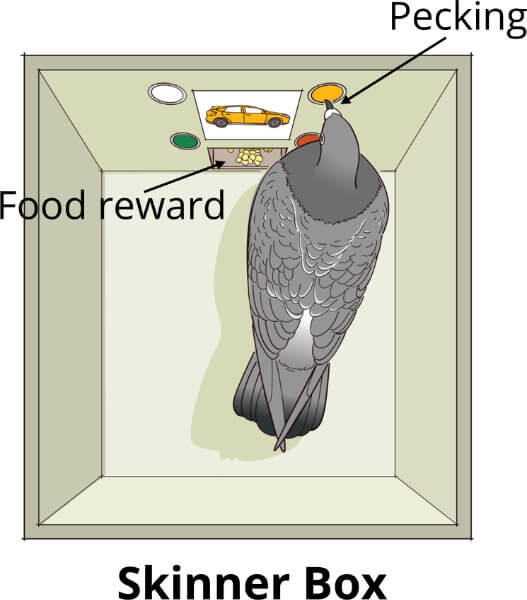
Famous psychologist B. F. Skinner conducted several experiments in the 1970s, in which he placed pigeons in a so-called Skinner Box (see image above) under different reinforcement schedules:

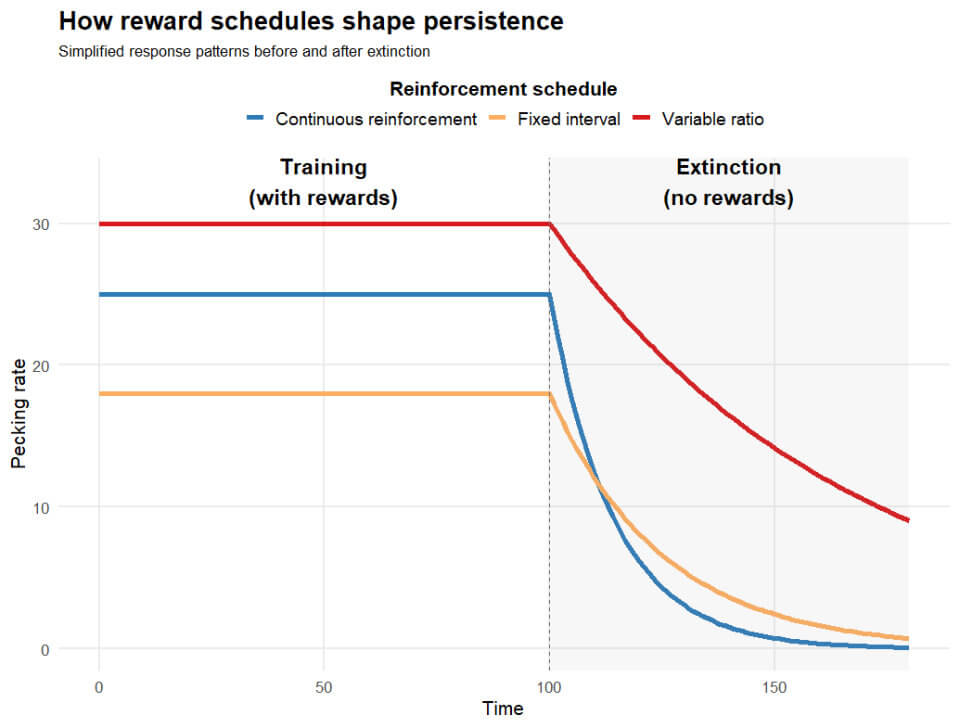
Pigeon 1: A food reward (e.g., pellets) was given immediately after each peck (continuous reinforcement). This pigeon quickly learned that every peck is rewarded.

Pigeon 2: A reward became available every fixed interval, but only if the pigeon pecked the key (fixed-interval schedule). This pigeon learned to peck more frequently towards the end of each interval.

Pigeon 3: A reward was after an unpredictable number of pecks (variable-ratio schedule). This pigeon pecked at a fast and steady rate.

Now, after some time had passed, Skinner put the pigeons back in the box, but this time no rewards were given whatsoever, no matter how often they pecked the key.

What do you think happened?

Well, Pigeon 1 soon lost interest and quickly stopped pecking, as it had learned there would be no reward. Pigeon 2 took longer to give up, presumably because periods without reward had been a normal part of its previous experience. Pigeon 3, however, continued pecking for a long time, even when no reward appeared. The reason for this behaviour is that it had learned that rewards were unpredictable. It thought that even after many unsuccessful attempts, a successful one might still appear. So, Pigeon 3 did not interpret the absence of reward as “it is over”, but rather as “it has not happened… yet”.

We can extend this reasoning to the strategy Stanley’s father uses to keep exploiting him. In-between bouts of abuse, he occasionally administers “rewards”, such as saying “I love you” or “I’ll get you anything you want”. These moments are emotionally strong, and Stanley remains obedient because he is desperate for his father’s affection. In effect, he is left thinking, “Maybe today my father will be kind to me”. That is how his father maintains control and emotional dependence.

When Stanley tells his father that he needs to be nicer to him, his father simply replies “Go to bed”. It is unclear what will become of Stanley, but it seems likely that his father will remain the same abusive figure he has always been.

Coincidence? I think not.

The prelude at the beginning of the movie appears to set the stage for what Magnolia will be about: that coincidences are significant. Before arguing about whether coincidences do occur in Magnolia, let’s first define coincidence.

Oxford Learner’s Dictionary (my go-to for definitions) defines coincidence as “the fact of two things happening at the same time by chance, in a surprising way”. In other words, (1) two or more independent events need to (2) converge at a particular time or place, such that (3) the convergence feels surprising and not planned or intentional.

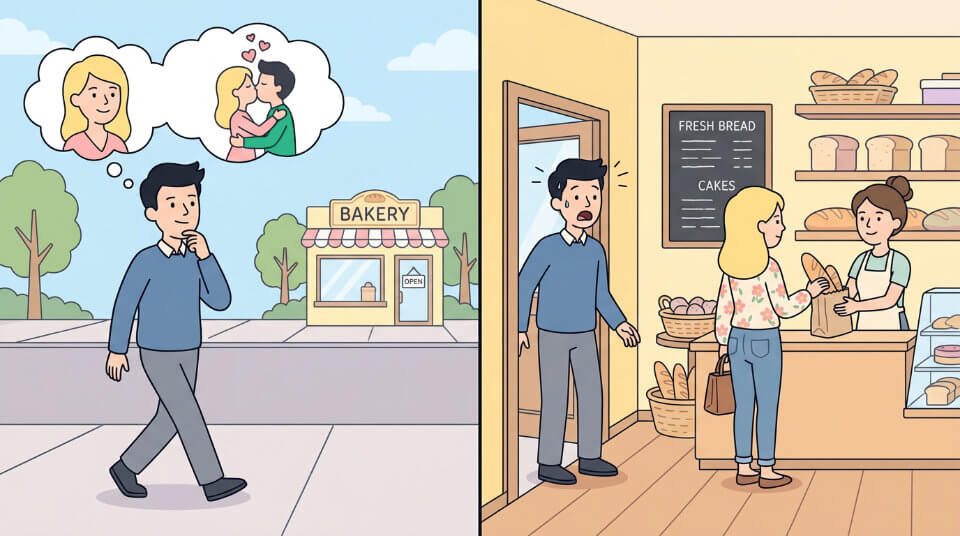
For example, let’s say I’m on my way to the bakery and start to think about my ex-girlfriend, whom I haven’t seen in years. Then, when I arrive at the bakery ten minutes later, there she is, buying bread.

Now, these two events (me thinking about my ex-girlfriend, and her going to the bakery) are independent: my thinking didn’t cause her to go to the bakery, and her going to the bakery didn’t cause my thinking (i.e., they are independent). However, they converge at the same time and place (at the bakery), and neither of us planned this to happen (lack of intention or design). Finally, it is a very surprising situation, as we hadn’t seen each other for several years.

This is a pure coincidence: it fits all the three criteria outlined above. The two events are independent, but it is the timing of their unfolding that makes this a coincidence.

Coincidences vs inevitable convergence

OK, what about Magnolia? Are there any coincidences among the different characters?

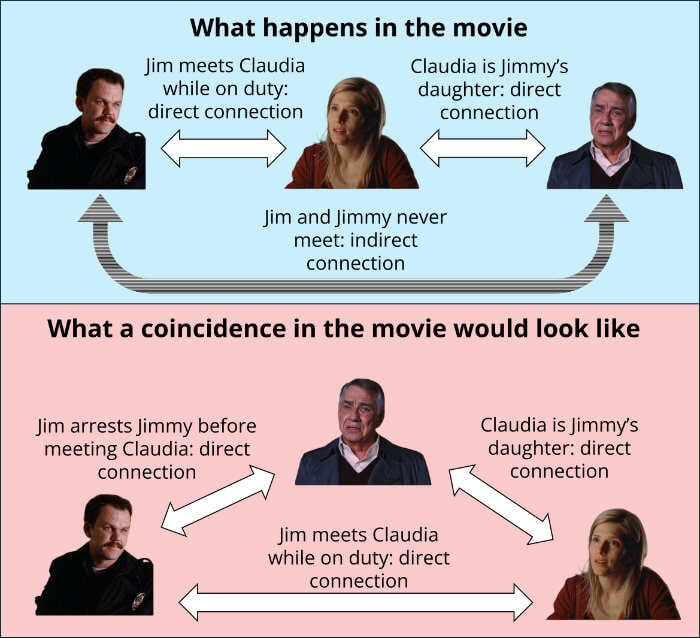
Not really. At least, not in the strict definition of the word. In most cases, the film depicts indirect connections rather than coincidences. Think of the way Jim is linked to Jimmy: Jim -> Claudia -> Jimmy. The link between Claudia and Jimmy is a direct father-daughter relationship, whereas the connection between Jim and Claudia is professional. Thus, the link between the otherwise unrelated characters Jim and Jimmy is purely indirect. Their storylines never unexpectedly converge; they are only connected through Claudia.

So, what would a coincidence actually look like in Magnolia? For example, Jim arresting Jimmy before asking Claudia on a date, not knowing that Claudia was Jimmy’s daughter. Now, THAT would be a coincidence, because the events “Jim arrests Jimmy because of police duty” and “Jim later begins dating Claudia” are independent – neither action caused the other – but they unexpectedly converge in the same place.

You could presumably argue that Jim finding Donnie during the frog rain is a coincidence. After all, both are outside for different reasons, the events seem independent, and their meeting is unexpected. However, this would still be a very weak coincidence, since it is not unlikely they would meet given that they both live in the same geographical region. Think of it in this way: would you be more surprised if Jim had met Frank, Phil or even some other person that did not appear in Magnolia but lived in the area? I wouldn’t.

So, much of the film is not dealing with coincidences, but rather with interconnected stories, as a result of being in close geographical proximity or blood/professional ties.

These things happen

Both the prologue:

“This was not just a matter of chance. These strange things happen all the time” and the ending:

“And it is in the humble opinion of this narrator… that strange things happen all the time. And so it goes, and so it goes.”

allude to something fundamental: strange things happen all the time, but that doesn’t mean they are inconsequential or purely chance-related.

This is well exemplified by the frog rain, which many viewers might see as a simple absurd and chance event in the movie, most likely interpreted as a spiritual connection to the Exodus episode in the Bible.

However, I feel I need to pause here and remind everyone that the biblical passage in Exodus 8:1-15 doesn’t actually say that frogs literally fell from the sky in a “frog rain”. The Bible only mentions that land, houses and people were overrun by frogs:

Here is what the Bible actually says:

1 Then the Lord said to Moses, “Go to Pharaoh and say to him, ‘This is what the Lord says: Let my people go, so that they may worship me. 2 If you refuse to let them go, I will send a plague of frogs on your whole country. 3 The Nile will teem with frogs. They will come up into your palace and your bedroom and onto your bed, into the houses of your officials and on your people, and into your ovens and kneading troughs. 4 The frogs will come up on you and your people and all your officials.’”

5 Then the Lord said to Moses, “Tell Aaron, ‘Stretch out your hand with your staff over the streams and canals and ponds, and make frogs come up on the land of Egypt.’”

6 So Aaron stretched out his hand over the waters of Egypt, and the frogs came up and covered the land. 7 But the magicians did the same things by their secret arts; they also made frogs come up on the land of Egypt.

Exodus 8:1-7

This is important, because PTA mentioned that he only became aware of the connection to the Bible only during the shooting of the movie (ironically, this is actually a coincidence 😊).

Only Stanley is not surprised. He smiles saying “That is something that happens”. What does he mean by “something that happens”? Well, we need to realise Stanely is a frickin’ genius kid. Surely, he knows both the scientific explanation for animal rains. In the library, he is reading a bunch of books about meteorology, including some that mention rain frogs (such as The Book of the Damned by Charles Fort).

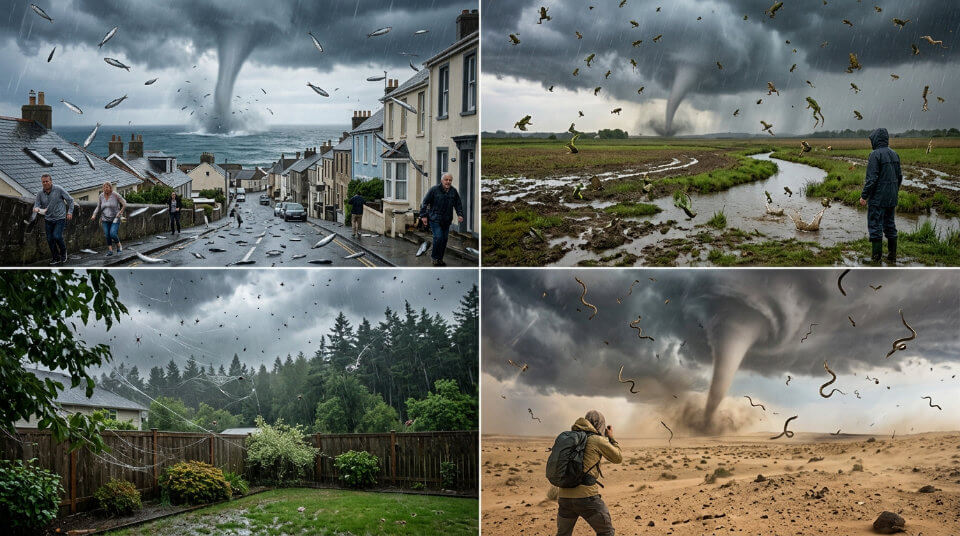
My take is that he is not surprised because he is aware that a frog rain is an actual phenomenon with a plausible scientific explanation. A frog rain is one of these freak occurrences that, if shown in a movie, you would probably say “it only happens in movies”. But it doesn’t, and that is really the point. Frog rain, though extremely rare, is an actual meteorological phenomenon, having occurred on several occasions in different parts of the world (and there are also reports of fish rain, locust rain, spider rain, and others).

But symbolically, the frog rain acts as a kind of wake-up call, which leads me to the next section.

Have you noticed that most animals that fall from the sky are small and light? You don’t see, for example, a cow rain (at least I hope not). That’s no coincidence.

For example, a fish rain occurs because watersprout (like a tornado but over water) sucks up lightweight stuff from the water, including small fish.

Strong atmospheric winds blow the watersprout into land, along with all the fish within it, sometimes reaching places much further than the original location of the waterprout formation.

When the storm is over, the spinning air loses its strength and is not able to hold the fish anymore. Because the fish are concentrated where the rotating column of wind was, they all dropped down around the same location over land.

These things just happen (albeit rarely).

The symbolism of the frog rain

The frog rain sits at the center of the internal conflict each main character in Magnolia is experiencing, and it is a pivotal moment that marks the beginning of the resolution of these conflicts.

Let’s take a step back and notice the positioning of the Aimee Mann’s song “Wise up”. It starts with Claudia, doing cocaine while waiting for Jim. Then we see Jim, distressed due to the blunder of losing his gun and feeling incompetent. Then Jimmy, sitting alone on his sofa after collapsing during the game show, wondering how to tell his wife what he did to Claudia. Then Donnie, shortly before deciding to rob the shop. Then Phil and Earl, after Earl has confessed cheating on Lily and abandoning Frank. Then Linda, sitting in her car after deciding to commit suicide out of guilt for her many affairs. Then Frank, also sitting in his car, pondering whether or not to go to Earl. Then Stanley, feeling embarrassed because of the peeing incident during the game show, sitting alone in the library.

Do you notice the pattern here?

This is all about how characters are experiencing their deepest lonileness.

But then, a form of emotional resolution begins to emerge: Jimmy confessing to his wife that he may have molested Claudia; Claudia and Jim opening up and sharing their vulnerabilities with one another; Frank finally releasing his pent-up aggression, crying unconsolably and begging for Earl not to leave him; Linda’s attempted suicide as an expression of the guilt she feels; Donnie realising he made a mistake by robbing the shop and trying to make amends.

Shortly after the rain frog commences, as if helping the characters come to terms with their loneliness and haunted pasts. For example, it causes Claudia’s mother to crash near Claudia’s house, initiating Claudia’s recovery from the trauma of the abuse she had suffered; it wakes Earl from his coma to allow a final reconciliation with Frank; it prevents Jimmy’s suicide; it causes the ambulance carrying Linda to arrive faster at the hospital entrance; it allows Jim to fulfill his wish of being the cop he always wanted to be; it forces some good sense into Donnie as he realises that his obsession with dental surgery is nothing but a manifestation of his need to be loved.

Also, note how the movie flips to a happier and much more hopeful song, where we see Frank visiting the hospital to reconcile with Linda; Stanley summoning the courage to stand up to his father; Donnie opening up about his feelings; Claudia and Jim working out their relationship.

So, I interpret the frog rain as a symbol of this shift from isolation and emotional fragmentation toward confrontation and reconciliation.

Magnolia as a graph

If you have read the knowledge post on Graph Theory, you will hopefully see how it is relevant to Magnolia, since Magnolia shows a case of a smaller version of such a graph.

Frank and Donnie couldn’t be furthest apart but at the same time, very close. Only a few connections and we see the path connecting Frank with Donnie. In theory, you could calculate all the metrics I described above and realise how tightly the Magnolia network is.

Naturally, I doubt PTA was thinking of Graph Theory when he was writing up the script. But it is a useful concept to have in mind when considering local networks such as the one presented in Magnolia.

Magnolia relies on this idea that people everywhere in the world aren’t as disconnected as they may seem. Our actions, our encounters, are not a product of coincidence or chance. They have a very physical and social explanation. This is particularly true now, with much of the world connected online, but it goes back to the beginning of civilisation.

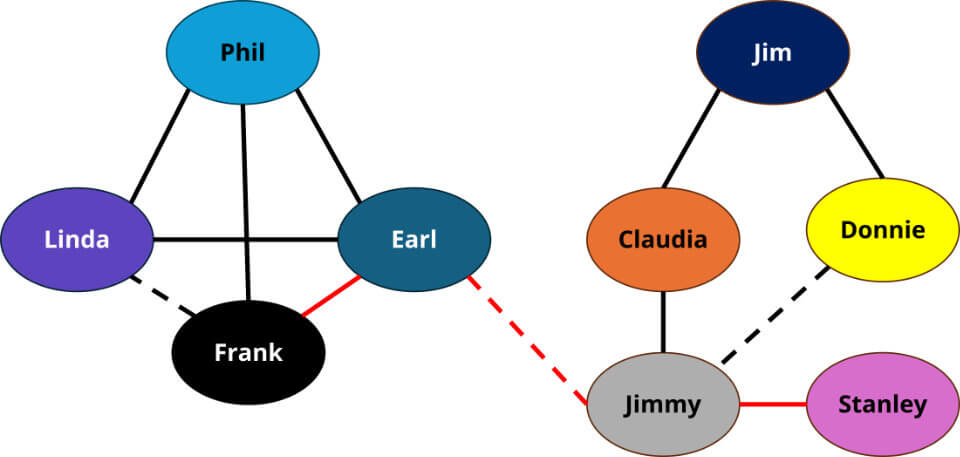
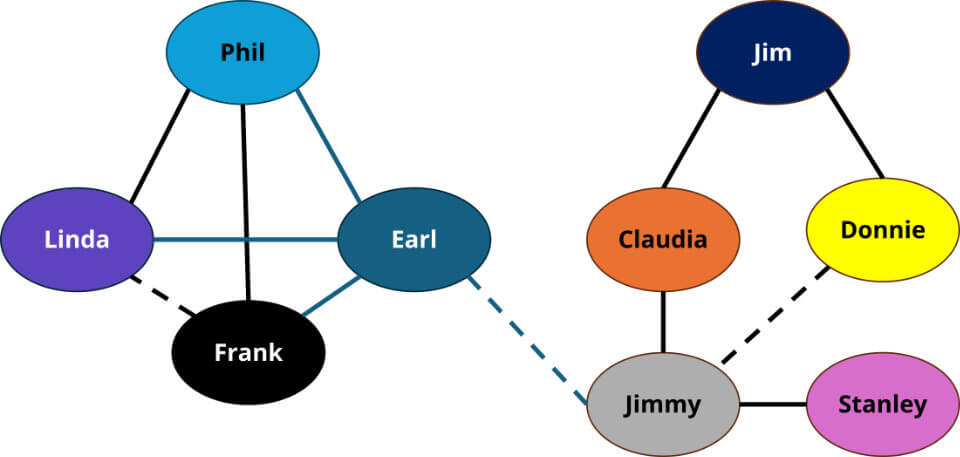
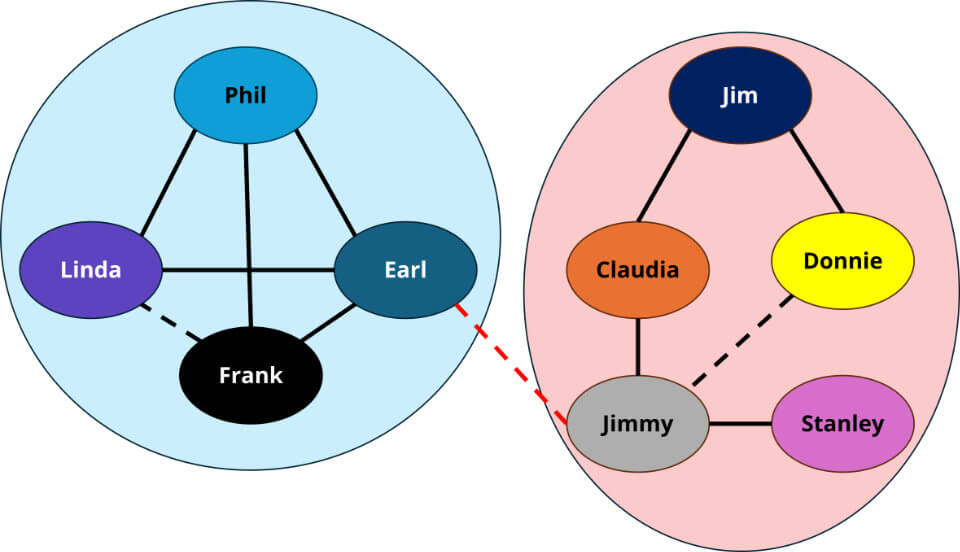
So, let’s imagine the Magnolia characters as a graph, like the one in the figure above. Each character is a node, and each connection from one character to another is an edge. Now, if you have read the explanation on graph theoretical measures above, you will immediately recognise this graph exhibits:

Clustering coefficient

If we look at the nodes in the red area we will see they are densely connected: for example, Phil is connected to Earl, Linda and Frank, and all three are connected with one another. The blue area nodes, on the other hand, have lower cluster coefficients (Jimmy has a value of 0, because the nodes it is connected to are not connected among themselves).

If we calculate the average clustering coefficient it would be CC(g) = 0.44, which is a moderate local cohesion (red nodes are tightly clustered, whereas blue nodes are not, lowering the average).

Path length (L)

Note how easy it is to reach any particular node from another node. Frank and Stanley are very distantly related and never meet in the movie. However, it only takes 3 edges to connect them.

The actual L is approximately 1.84, which is very low. You can think of it as on average, any node can reach another is about 2 steps.

Between centrality

Earl has a maximum betweenness of about 0.57 which is very high (for comparison, the other nodes have 0-0.14). That should be easy to see in the graph as Earl is a major bridge that connects the red and blue clusters.

Modularity

This one is very easy to see, as there are clearly two separate communities linked via Earl – Jimmy edge. A rough estimate of modularity for the Magnolia graph above would be Q = 0.36, a moderate community structure.

Conclusion

Nine events told within the same story – that’s how director PTA described Magnolia.

But in the end, we should understand that even though strange things happen, this doesn’t mean that everything is purely random or without structure. In Magnolia, interactions among characters are not simple chance events, as some of you might have concluded from the prelude; their crossovers are certainly not coincidences in the strict sense either. Rather, we see a network of causal and emotional links, where unresolved past experiences continue to influence present behaviour and relationships. The past becomes a major driver of these causal chains, continually leaking into the present.

Remember what the book says:

“We may be through with the past, but the past ain’t through with us”.

Leave a comment

Recommendations:

Add Your Recommendations

Popular Tags

This site is protected by reCAPTCHA and the Google Privacy Policy and Terms of Service apply.